
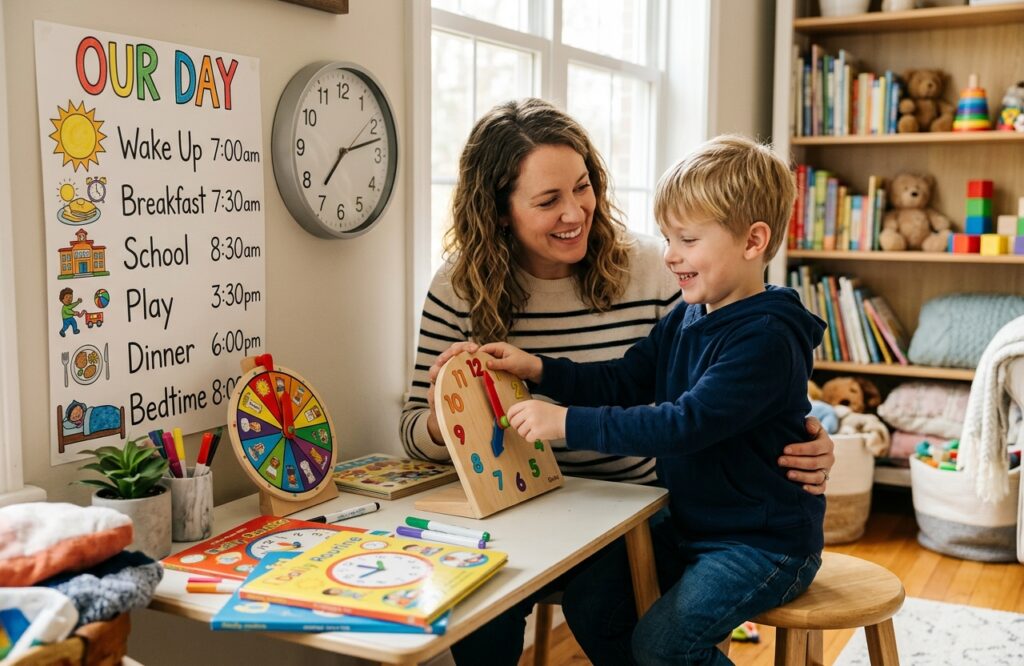
Learning to tell time is an important skill that helps children become more independent and understand how their daily lives are organised. However, learning the numbers and positions on a clock can sometimes feel confusing for young children. One of the most effective ways to make this concept easier is to connect time with activities they already know.
How to teach kids about telling time with routines is a practical approach because children can learn through familiar daily events such as waking up, eating breakfast, going to school, playing, and getting ready for bed. Instead of treating telling time as a difficult classroom lesson, parents and teachers can make it part of everyday life.
Using routines allows children to see why time matters and gives them regular opportunities to practise reading clocks and understanding schedules.
Why Are Routines Helpful for Teaching Time?
Children often understand concepts more easily when they can connect them to real experiences. A clock may initially look like a collection of numbers and moving hands, but a routine gives those numbers meaning.
For example, telling a child that breakfast starts at 8:00 is more meaningful when they regularly eat breakfast around that time. Similarly, saying that bedtime is at 8:30 helps children connect a specific time with a familiar activity.
Daily routines can help children:
- Recognise common times on a clock
- Understand the order of daily activities
- Develop a sense of duration
- Learn about morning, afternoon, and evening
- Become more aware of schedules
- Build independence and time management skills
Regular repetition also helps children remember what they have learned without making practice feel like a formal lesson.
Start With Familiar Daily Activities
When teaching children to tell time, begin with activities they experience every day. Choose three or four important parts of their routine and connect each one with a specific time.
For example, a morning routine could include:
7:00: Wake up
7:30: Get dressed
8:00: Eat breakfast
8:30: Leave for school
Ask children to look at an analogue clock and identify the time associated with each activity. At first, focus on the hour rather than expecting them to understand every minute.
This approach makes learning more practical because children can see that the clock helps them understand when something should happen.
Teach the Hour First
Young children may find it difficult to understand both clock hands at the same time. A useful starting point is teaching them to recognise whole hours.
Explain that the shorter hand is the hour hand and the longer hand is the minute hand. When the minute hand points to 12, the clock shows an exact hour.
For example, if the short hand points to 7 and the long hand points to 12, the time is 7:00.
Connect this lesson to routines by saying, “At 7:00, we wake up.” Later, change the example to another familiar activity.
Once children become comfortable recognising whole hours, you can gradually introduce half-hours, quarter-hours, and individual minutes.
Use a Visual Routine Chart
A routine chart can make learning about time more engaging. Create a simple chart containing pictures or descriptions of daily activities alongside their times.
For example:
| Activity | Time |
|---|---|
| Wake up | 7:00 |
| Breakfast | 8:00 |
| School | 8:30 |
| Lunch | 12:30 |
| Playtime | 4:00 |
| Dinner | 6:30 |
| Bedtime | 8:00 |
Encourage children to check the chart during the day. Ask questions such as, “What time is dinner?” or “What do we do at 4:00?”
This gives children repeated practice while helping them understand how different activities fit into a daily schedule.
Turn Everyday Moments Into Practice
Parents do not need special equipment to help children practise telling time. Everyday moments can become learning opportunities.
If you are preparing lunch, ask, “What time is it?” When it is almost time to leave for school, ask the child to check the clock. Before bedtime, ask them to identify the current time.
You can also ask questions that encourage children to think about time rather than simply read a clock.
For example:
- “What time do we usually leave for school?”
- “How long until dinner?”
- “What time will bedtime begin?”
- “What activity comes after lunch?”
- “Is it morning or afternoon?”
These questions encourage children to connect clock reading with real-life time management.
Teach Elapsed Time Through Routines
Once children understand basic clock reading, introduce the idea of elapsed time. This means helping them understand how much time passes between two activities.
For example, if playtime begins at 4:00 and dinner starts at 5:00, ask how much time the child has for playing.
Start with simple examples involving one-hour differences. Later, introduce shorter periods such as 30 minutes or 15 minutes.
You can also use a timer during activities. Ask children to estimate how long it will take to complete a simple task and then compare their estimate with the actual time.
This helps children understand that time is not only something shown on a clock but also something that passes during activities.
Make Time Learning Interactive
Children often learn better when they are actively involved. Instead of always asking them to read a clock, let them move the hands themselves.
A teaching clock with movable hands can be particularly useful. Give the child a routine-based instruction such as, “Show me 7:00 because that is wake-up time.”
You can then make the activity more challenging:
“Show me 8:30 because that is breakfast time.”
Another fun activity is to describe an activity and ask the child to identify its time. You can also show a clock and ask them which part of the routine belongs to that time.
Interactive practice keeps children interested and gives them opportunities to learn from mistakes.
Keep Practice Consistent and Positive
Learning to tell time takes practice. Children should not be expected to understand every concept immediately. Some may learn quickly, while others need more repetition.
Keep practice sessions short and relaxed. Five to ten minutes of regular practice can be more effective than a long lesson that makes the child frustrated.
Praise effort as well as correct answers. If a child gives the wrong answer, calmly explain how to find the correct time.
The goal is to make children feel confident about using clocks rather than nervous about making mistakes.
Gradually Increase the Difficulty
After children understand whole hours, introduce half-hours. Once they are comfortable with those, move to quarter-hours and then five-minute intervals.
For example, you might progress from:
7:00 → 7:30 → 7:15 → 7:45 → 7:20
Connect every new concept to a routine whenever possible. This gives children a practical reason to understand the time.
As their skills improve, encourage them to read digital clocks as well as analogue clocks. Understanding both formats can help children recognise time in different situations.
Conclusion
Learning how to tell time does not have to be complicated or stressful. By connecting clocks with familiar routines, parents and teachers can turn an abstract concept into a practical everyday skill.
The most effective approach to how to teach kids about telling time with routines is to begin with familiar activities, teach whole hours first, use visual schedules, practise throughout the day, and gradually introduce more advanced concepts.
With consistency, encouragement, and plenty of real-life examples, children can develop stronger clock-reading skills while also learning valuable lessons about schedules, responsibility, and independence.