

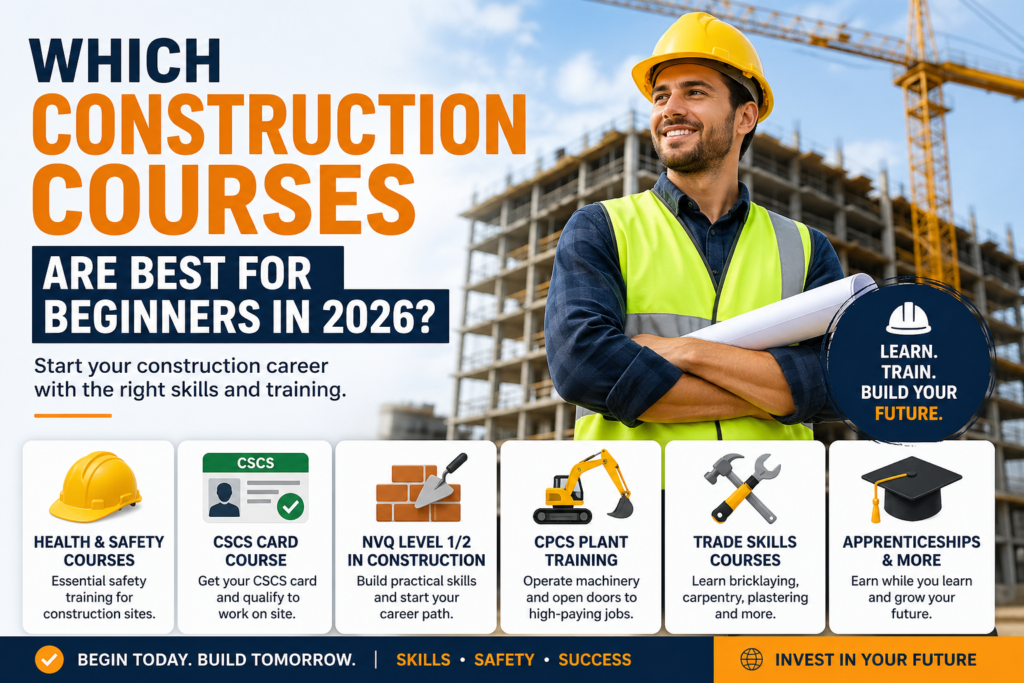
Starting a career in construction can be one of the smartest decisions in 2026. The industry continues to grow, offering strong job security, competitive salaries, and clear progression paths. However, if you’re new to the field, the biggest question is, which construction courses should you take first?
The answer depends on your goals, but for beginners, the best courses are those that focus on basic safety, practical skills, and recognised certifications that employers value.
In this guide, we’ll break down the best construction courses for beginners, what they include, and how to choose the right path.
Why Construction Courses Matter in 2026
Construction is no longer just about physical labour—it requires skills, qualifications, and safety knowledge. Most employers now expect workers to have certified training before stepping onto a site.
Courses help you:
- Learn essential safety procedures
- Gain hands-on practical skills
- Improve employability
- Qualify for site access cards
In fact, recognised qualifications like NVQs and CSCS-related training are often required to prove competence and work safely on-site
Top Construction Courses for Beginners
The best beginner construction courses focus on safety, practical skills, and recognised certifications to help you start your career quickly.
1. Level 1 Health and Safety in Construction Environment
This is the best starting point for absolute beginners.
Why it’s important:
- Introduces basic site safety rules
- Required for entry-level roles
- Helps you qualify for a CSCS Labourer Card
This course teaches:
- Risk awareness
- Hazard identification
- Safe working practices
It is often the first step before entering any construction job, especially for those applying for labourer roles
2. CSCS Card Course (Labourer Card)
The CSCS (Construction Skills Certification Scheme) is essential for working on most UK construction sites.
What it includes:
- Health & Safety test
- Basic construction knowledge
- Proof of competency
CSCS courses cover areas like:
- Working at height
- Tool handling
- Fire safety
- Site regulations
👉 Without a CSCS card, many employers won’t allow you on-site.
3. NVQ Level 1 in Construction
The NVQ Level 1 is a beginner-friendly qualification designed for people with little or no experience.
Key benefits:
- Work-based learning
- No formal exams
- Recognised by employers
This course focuses on:
- Basic construction tasks
- Site responsibilities
- Teamwork and safety
It’s ideal for entry-level labourers starting their career and helps build real on-site experience
4. NVQ Level 2 in Construction Trades
Once you gain basic knowledge, the next step is NVQ Level 2, which focuses on specific trades.
Popular beginner trade courses:
- Bricklaying
- Carpentry
- Plastering
- Painting and decorating
These courses:
- Develop specialised skills
- Lead to better-paying jobs
- Help you qualify for a skilled worker CSCS card
NVQ Level 2 is considered the standard qualification for skilled construction workers
5. Construction Apprenticeships
Apprenticeships are one of the best routes for beginners who prefer earning while learning.
Why choose an apprenticeship:
- Get paid while training
- Gain real work experience
- Learn directly from professionals
You’ll typically combine:
- On-site work
- Classroom learning
- NVQ qualification
This is one of the most practical ways to start a long-term construction career.
6. CPCS Plant Training Courses
If you’re interested in operating machinery, CPCS (Construction Plant Competence Scheme) courses are a great option.
Examples include:
- Excavator training
- Dumper truck operation
- Crane operation
These courses:
- Provide specialist skills
- Offer higher earning potential
- Are in high demand
Many CPCS courses also include practical certifications that help you secure jobs quickly
7. Short Construction Skills Courses
Short courses are ideal for beginners who want quick entry into the industry.
Examples:
- Manual handling
- Working at height
- Fire safety awareness
These courses:
- Take a few days to complete
- Improve your CV
- Help you stand out to employers
They are often used alongside other qualifications like CSCS and NVQs.
Best Construction Course Path for Beginners (Step-by-Step)
If you’re unsure where to start, follow this proven path:
Step 1: Start with Safety Training
👉 Level 1 Health & Safety Course
Step 2: Get Your CSCS Card
👉 Required for most construction jobs
Step 3: Choose a Trade
👉 Bricklaying, carpentry, or general labour
Step 4: Enrol in NVQ Level 1 or 2
👉 Gain practical skills and certification
Step 5: Gain Experience or Apprenticeship
👉 Build real-world experience
This structured approach ensures you progress quickly and safely.
Which Course Is Best for You?
Choosing the right course depends on your goals:
If you want quick entry:
- Health & Safety Course
- CSCS Card
If you want a skilled trade:
- NVQ Level 2
If you want high-paying roles:
- CPCS Plant Courses
If you prefer hands-on learning:
- Apprenticeships
What Construction Courses Should Beginners Avoid?
Not all courses are suitable for beginners.
Avoid:
- Advanced NVQ Level 6 (management level)
- Specialist courses without basic knowledge
Higher-level NVQs are designed for experienced professionals, not beginners
Benefits of Taking Construction Courses
Investing in the right training offers long-term advantages:
✅ Better job opportunities
✅ Higher earning potential
✅ Safer working environment
✅ Career progression
Construction courses are designed to match real job roles and on-site skills, making them highly practical and valuable
Career Opportunities After Beginner Courses
Once you complete beginner-level construction courses, you can apply for roles such as:
- Construction labourer
- Bricklayer assistant
- Site operative
- Painter and decorator
- Groundworker
With experience and further training, you can progress to:
- Skilled tradesperson
- Supervisor
- Site manager
Final Thoughts
In 2026, the best construction courses for beginners are those that provide practical skills, recognised certifications, and a clear career pathway.
If you’re starting from scratch, begin with:
- Health & Safety training
- CSCS certification
- NVQ Level 1 or 2
From there, you can specialise in a trade or move into higher-paying roles.
The construction industry rewards those who invest in their skills—so choosing the right course today can shape your entire career tomorrow.
Frequently Asked Questions (FAQs)
1. What is the best construction course for beginners?
The Level 1 Health and Safety in Construction course is the best starting point.
2. Do I need a CSCS card to work in construction?
Yes, most UK construction sites require a CSCS card to prove safety knowledge.
3. How long do construction courses take?
Beginner courses can take from 1 day to a few weeks, while NVQs may take several months.
4. Are construction courses worth it?
Yes, they improve job opportunities, skills, and earning potential.
5. Can I get a job after a construction course?
Yes, many entry-level roles are available after completing basic training.
6. Which trade is best in construction?
Popular beginner trades include bricklaying, carpentry, and plastering.
7. Do I need experience before taking a construction course?
No, most beginner courses are designed for people with no prior experience.
