
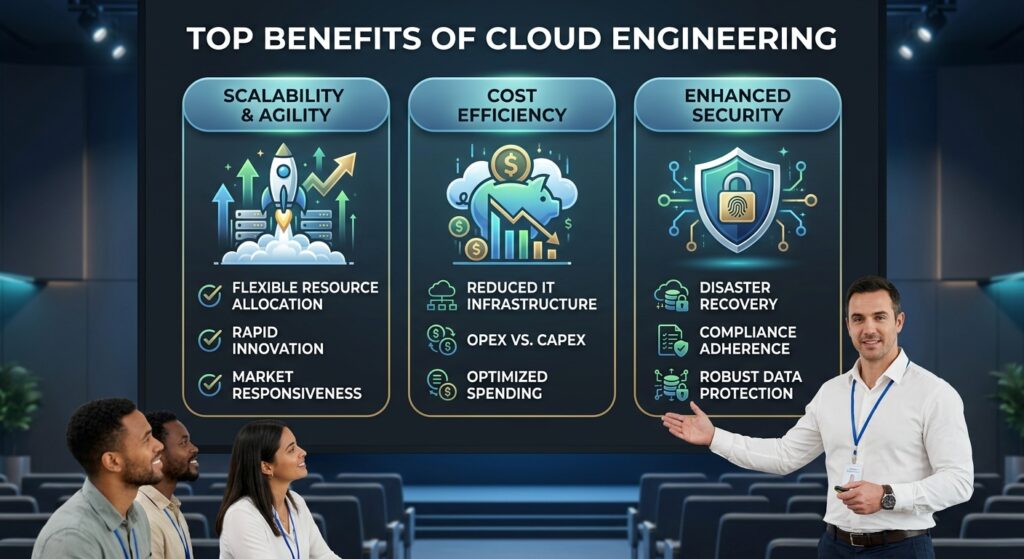
Cloud technology has become an important part of modern business infrastructure. Organizations of different sizes are moving applications, data, development environments, and business workloads to the cloud to improve flexibility and support changing operational needs. However, simply moving systems to a cloud platform does not guarantee better performance or efficiency.
Businesses also need the right architecture, security controls, automation, monitoring, and operational processes. This is where Cloud Engineering Services can provide practical value. Cloud engineering focuses on designing, building, deploying, and managing cloud environments so that technology infrastructure can support business objectives.
What Are Cloud Engineering Services?
Cloud engineering involves applying engineering principles to cloud infrastructure and applications. It can include cloud architecture, migration, infrastructure automation, DevOps, security, performance optimization, monitoring, and ongoing management.
Rather than treating the cloud as simply a place to host applications, businesses can use engineering practices to build environments that are reliable, scalable, secure, and easier to maintain.
1. Improved Scalability
One of the major advantages of cloud infrastructure is the ability to scale resources according to demand.
Traditional infrastructure often requires businesses to purchase physical servers based on expected future requirements. If demand increases unexpectedly, available resources may become insufficient. On the other hand, purchasing too much infrastructure can result in unnecessary costs.
Cloud environments can be designed to scale resources based on workload requirements.
Handle Changing Demand
For example, an online business may experience significant traffic increases during seasonal promotions. A properly engineered cloud environment can accommodate changing workloads without requiring the organization to permanently maintain infrastructure for peak demand.
2. Better Infrastructure Flexibility
Cloud engineering gives businesses greater flexibility when designing and operating their technology environments.
Teams can select services and architectures based on application requirements rather than being limited by physical infrastructure. Development, testing, staging, and production environments can also be created and managed more efficiently.
This flexibility can help organizations experiment with new technologies while reducing the time required to provision infrastructure.
3. Greater Cost Efficiency
Cloud computing can help organizations avoid some of the large upfront expenses associated with physical infrastructure. However, cloud costs can still increase rapidly when resources are poorly configured or left unused.
Cloud engineering practices can help businesses monitor resource consumption and optimize infrastructure.
For example, teams can identify underutilized resources, automate resource provisioning, and select appropriate compute and storage options.
The objective is not simply to reduce cloud spending but to ensure that infrastructure resources are aligned with actual business requirements.
4. Improved Security
Security should be considered throughout the cloud engineering lifecycle rather than added after infrastructure has been deployed.
Cloud environments can incorporate identity and access management, encryption, network controls, monitoring, vulnerability management, and automated security policies.
Build Security Into Infrastructure
Engineering teams can also use infrastructure-as-code and automated testing to apply security configurations consistently across environments.
This reduces the risk of configuration differences and makes it easier to identify potential security issues before they affect production systems.
5. Faster Software Delivery
Cloud engineering often works closely with DevOps practices to automate development and deployment processes.
Instead of manually configuring servers and deploying applications, teams can create repeatable pipelines that automatically test, build, and deploy software.
This can reduce deployment time and allow development teams to release updates more frequently while maintaining greater consistency.
6. Increased Reliability and Availability
Business applications need to remain available even when individual components experience problems.
Cloud engineering can support reliability through practices such as load balancing, redundancy, automated backups, monitoring, disaster recovery, and fault-tolerant architecture.
A well-designed environment can reduce the impact of infrastructure failures and provide businesses with better continuity.
7. Easier Infrastructure Automation
Manual infrastructure management can become difficult as environments grow.
Automation allows teams to define infrastructure configurations and deploy them consistently. Infrastructure-as-code tools can help organizations create repeatable environments without manually configuring every component.
This can reduce human error and make infrastructure changes easier to review and reproduce.
8. Better Monitoring and Performance Management
Cloud environments generate large amounts of operational data. Monitoring tools can provide visibility into application performance, resource usage, system health, and potential failures.
Businesses can use this information to identify bottlenecks and optimize workloads.
Use Data to Improve Performance
Performance monitoring can reveal issues such as high resource utilization, slow application responses, inefficient database queries, or unexpected traffic patterns.
Addressing these issues proactively can improve user experience and reduce the risk of service disruptions.
9. Supports Digital Transformation
Cloud engineering can provide the technical foundation for broader digital transformation initiatives.
Businesses can modernize legacy applications, introduce automation, build data platforms, adopt AI solutions, and connect distributed systems using cloud-based infrastructure.
Companies such as CodeCones work across cloud engineering, software development, data engineering, and DevOps to help organizations build and modernize technology environments.
How Businesses Can Get Started
Organizations considering cloud engineering should begin by assessing their existing infrastructure and identifying specific business goals.
A practical approach includes:
- Assess current infrastructure and identify technical limitations.
- Define business requirements such as scalability, availability, security, or cost optimization.
- Choose an appropriate cloud architecture based on application and workload requirements.
- Prioritize migration and modernization projects instead of changing everything simultaneously.
- Automate repetitive infrastructure processes where possible.
- Monitor performance, security, and costs continuously.
- Review the environment regularly as business requirements evolve.
Conclusion
Cloud engineering is about more than moving applications to the cloud. It involves designing and managing infrastructure in a way that supports scalability, security, reliability, automation, and long-term business growth.
The right Cloud Engineering Services can help organizations build stronger technology foundations while making infrastructure easier to manage and adapt. From improving application performance to supporting faster software delivery and digital transformation, cloud engineering can provide benefits across many areas of modern IT operations.
Businesses should begin by understanding their current infrastructure challenges and defining clear objectives before selecting technologies or service providers. A well-planned cloud strategy combined with sound engineering practices can create a more flexible and reliable environment for future growth.