
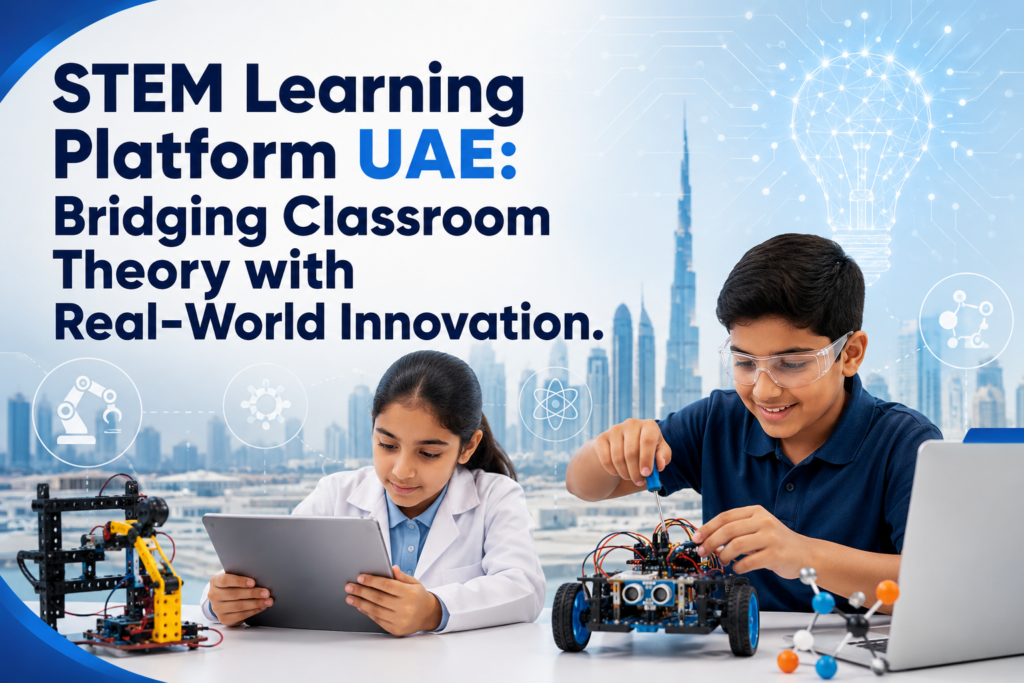
If you’ve spent any time around a school in Dubai or Sharjah lately, you’ve probably noticed something. Kids aren’t just memorizing formulas anymore — they’re building things, coding things, testing things that actually break and get fixed. That shift didn’t happen by accident. A good STEM Learning Platform UAE schools trust is usually behind it, quietly changing how science and math get taught from the inside.
I’ve worked with schools, parents, and curriculum teams across the region for over a decade now, and the question I get asked most often is some version of: “My kid does well in exams, so why does he freeze the moment I ask him to apply for it?” Honestly, it’s a fair question. Traditional classrooms are built to test recall. They’re not built to test whether a student can look at a broken circuit and figure out what went wrong. That gap between “knowing” and “doing” is exactly what a solid platform is meant to close.
Why Theory Alone Isn’t Cutting It Anymore
Here’s something I’ve seen play out again and again. A student can ace a physics paper on electromagnetism and still have no idea how to wire a simple sensor. That’s not the student’s fault — it’s the system’s. Textbooks are static. The world isn’t.
The UAE has been pushing hard on Emerging Technology Education UAE initiatives for a reason. Employers here aren’t just looking for people who passed exams; they want people who’ve actually touched AI tools, built a small robot, or debugged code that didn’t run the first time. That’s a different skill set entirely, and it’s one that develops through repetition and failure, not lectures.
A learning platform that mixes theory with hands-on practice gives students that repetition. They build a solar-powered car, it doesn’t move, they figure out why, they try again. That loop — try, fail, adjust — is where actual learning happens. Not in the textbook chapter that comes before it.
What Makes a STEM Learning Platform Actually Work
Not every platform labeled “STEM” does this well. I’ve seen plenty that are really just gamified worksheets with a shiny interface — same rote learning, dressed up differently. A platform that genuinely bridges the gap between classroom and reality tends to have a few things in common.
First, it’s project-based, not lesson-based. Students aren’t clicking through slides; they’re building something across several sessions, hitting problems along the way. Second, it connects to real careers. When a 12-year-old builds a basic AI model and realizes companies actually pay people to do that, motivation changes completely. Third, and this one gets overlooked a lot, it has proper teacher and mentor support behind it. Software alone doesn’t teach engineering thinking — a mentor asking “why do you think that happened?” does.
This is also where a Best STEM Training Institute UAE parents ask me about tends to separate itself from the rest. It’s rarely about flashy branding. It’s about whether the instructors actually know how to guide a stuck 10-year-old without just handing over the answer.
Robotics: Where the Learning Becomes Visible
Out of everything I’ve watched students work with, robotics tends to click the fastest — probably because the result is immediate. You build it, you power it on, and it either moves the way you wanted or it doesn’t. There’s no ambiguity.
Robotics Classes for Kids UAE programs work well precisely because failure is visible and fixable in the same sitting. A kid whose robot arm won’t lift a block has to think through torque, balance, and code logic all at once, without realizing that’s technically an engineering problem. They just think of it as “getting the arm to work.” That’s the whole point — the learning sneaks in through the doing.
Parents sometimes worry robotics is too advanced for younger kids. In my experience it’s the opposite. Younger students are often more comfortable experimenting without fear of “getting it wrong,” which honestly makes them better at this kind of iterative building than teenagers who’ve been trained to chase the right answer on the first try.
Setting Up the Right Environment Matters More Than People Think
A platform is only as good as the space it runs in. I’ve walked into schools with excellent curriculum plans and a lab that’s basically a storeroom with some wires in it. That mismatch kills engagement fast.
Working with a proper STEM Lab Setup Company UAE schools can rely on makes a bigger difference than most administrators expect going in. It’s not just about buying equipment — it’s about designing a space where twenty kids can work on ten different projects without chaos, where tools are accessible, and where the layout actually supports group problem-solving instead of rows of desks facing a board. A well-designed lab quietly does half the teaching before the instructor even says a word.
AI Isn’t Optional Anymore, Even for Younger Students
A few years back, AI education felt like something reserved for university-level computer science. That’s changed fast, and honestly, it needed to. An AI Course for Kids Dubai parents enroll their children in today usually starts simple — teaching pattern recognition through games, or showing how a chatbot predicts the next word. Kids don’t need to understand neural network math to grasp the logic behind it.
What matters is exposure early. Students who get comfortable with AI concepts at 10 or 11 don’t panic when they encounter more complex applications later. They’ve already built the mental model. This is one area where waiting until high school genuinely puts students behind, because by then, their peers who started earlier have a real head start in how they think about problems.
What Parents Should Actually Look For
If you’re a parent trying to pick a platform for your child, skip the marketing brochures for a minute and ask a few blunt questions instead. Does the platform involve building real projects, or mostly watching videos? Do students work in teams, or alone on a screen? Is there a mentor who checks in on progress, or is it self-paced with no accountability?
I’d also say — don’t judge a program purely by how advanced the tech sounds. A basic robotics kit taught well beats an expensive AI simulation taught poorly, every time. The tools matter less than the thinking they’re used to build.
Practical Takeaway
The real value of a good STEM Learning Platform UAE program isn’t the equipment or the software license — it’s the habit of thinking through problems by actually engaging with them, not just reading about them. Classroom theory gives students the vocabulary. Hands-on platforms give them the fluency to actually use it.
If your child is currently strong on paper but hesitant when asked to apply what they know, that’s usually a sign it’s time to look beyond textbooks. Programs like those run by Stem-Xpert focus exactly on that gap — combining robotics, AI exposure, and proper lab environments so kids aren’t just learning STEM concepts, they’re using them. Whether it’s through structured robotics classes for kids UAE or early-stage AI course for kids Dubai modules, the goal stays the same: build students who can actually do something with what they know, not just recite it back on exam day.
Frequently Asked Questions
1. What is a STEM Learning Platform, and how is it different from regular school science classes?
A STEM Learning Platform combines science, technology, engineering, and math through hands-on projects like robotics and coding, rather than textbook-only instruction. Regular classes focus on theory and exams; a STEM platform focuses on applying that theory to build and test real solutions.
2. At what age should a child start STEM learning in the UAE?
Most educators suggest starting between ages 6 and 8, when kids are naturally curious and less afraid of making mistakes. Early exposure to robotics and basic coding builds problem-solving habits that carry into more advanced learning later.
3. Are STEM learning platforms only useful for kids interested in engineering careers?
No. The core skills — logical thinking, troubleshooting, teamwork — apply to almost any career path, not just engineering. Many students who go through STEM programs end up in fields like design, business, or medicine, and still use that problem-solving foundation.
4. How do robotics classes for kids in the UAE actually help academic performance?
Robotics forces students to apply math and physics concepts practically, which reinforces classroom learning. Students often understand abstract topics like force, torque, or circuits better after building something that requires those concepts to work correctly.
5. What should parents check before choosing a STEM training institute in the UAE?
Look for project-based learning, qualified mentors, small class sizes, and a proper lab setup rather than just software subscriptions. It’s also worth asking how much of the program is hands-on versus video-based instruction.
6. Is AI education appropriate for young children, or is it too advanced?
AI concepts can be simplified effectively for children as young as 8 or 9 through games and visual tools that teach pattern recognition and logic. They don’t need to understand the underlying math to grasp how and why AI makes decisions.