
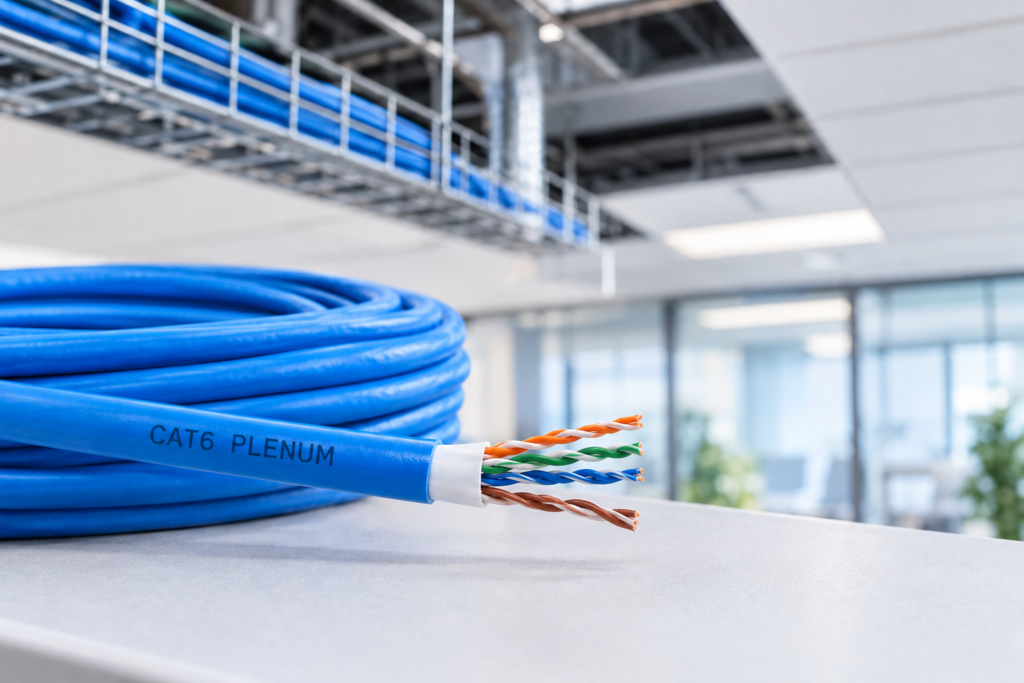
Behind the ceiling tiles of most commercial buildings, there’s a network that people rarely see but constantly depend on. Point-of-sale systems, video conferencing, security cameras, wireless access points, and cloud applications all rely on cabling that has to perform consistently and meet the building’s safety requirements.
Choosing that cabling means balancing two things: dependable connectivity and suitability for the spaces where the cable will run. Cat6 Plenum Cables address both. They offer the performance of Cat6 Ethernet cable along with a jacket designed for air-handling spaces, where building codes often set stricter rules.
This article explains how these cables work, where they fit, and what to keep in mind when planning commercial network cabling.
What Makes Cat6 Plenum Cables Different?
Cat6 cable construction
Cat6 is a category of twisted-pair Ethernet cable. Inside the jacket, four pairs of copper conductors are twisted together to reduce interference, and many designs include a separator between the pairs. Cat6 supports Gigabit Ethernet and, over shorter distances, 10 Gigabit Ethernet.
What “plenum-rated” means
A plenum-rated cable has an outer jacket and insulation tested for limited flame spread and low smoke production. In the United States, this is generally associated with the CMP rating under the National Electrical Code (NEC). The rating describes the materials, not the speed at which data travels.
Purpose of the plenum-rated jacket
The jacket is typically made from low-smoke, flame-retardant compounds such as FEP, rather than standard PVC. Its purpose is to meet the requirements for spaces where air circulates through the building. That is why these cables are designed for particular areas rather than being just another Ethernet cable option.
Understanding Plenum Spaces in Commercial Buildings
A plenum is a space that carries air as part of a building’s heating, ventilation, and air conditioning (HVAC) system. Common examples include:
- Spaces above suspended ceilings, when they are used for air return
- Air-handling spaces between floors or within mechanical areas
- Other areas used for air circulation, such as certain raised-floor cavities
These spaces matter because air moves through them freely. In a fire, smoke and combustion byproducts can spread through the plenum to other parts of the building. For that reason, codes often require cables installed there to meet stricter flame and smoke criteria.
A ceiling cavity is not always a plenum, and some buildings use ducted returns instead. Installations should comply with applicable building codes, standards, and project requirements, so confirm the classification with the designer, installer, or authority having jurisdiction (AHJ).
How Cat6 Plenum Cables Support Network Connectivity
Plenum rating relates to the jacket, but the cable underneath is still Cat6. That means the following apply when it is installed within specification.
- High-speed data transmission: Cat6 supports Gigabit speeds across a standard channel and 10GBASE-T over shorter distances, typically up to about 55 meters depending on conditions.
- Bandwidth and network capacity: Cat6 is specified up to 250 MHz, compared with 100 MHz for Cat5e, which gives more headroom for busy networks.
- Signal integrity: Quality conductors and consistent construction help maintain a clean signal along the run.
- Reduced interference and crosstalk: Twisted pairs and pair separation help limit noise between wires, which is especially useful in dense bundles.
- Importance of proper installation: Even a well-made cable can underperform if it is poorly terminated, over-bent, or run beyond its length limits.
- Suitability for modern business applications: VoIP, video calls, IP cameras, wireless access points, and cloud services all work well within Cat6 capabilities.
Real-world speeds depend on the connected equipment, cable length, and installation quality, and no cable can exceed its rated specifications.
How Cat6 Plenum Cables Support Building Safety
Jacket characteristics
Plenum jackets are formulated to resist flame spread and produce limited smoke when tested under standardized conditions, such as NFPA 262 in the United States.
Fire and smoke considerations
Smoke affects visibility and air quality during an emergency, so low-smoke materials are a sensible choice in spaces that move air through the building. A lower-smoke jacket is one part of a building’s broader fire safety approach.
Why they’re used in air-handling spaces
Because air-handling spaces can carry smoke widely, codes commonly call for plenum-rated cable in them.
Following codes and requirements
A plenum rating does not make a cable fireproof, and it does not eliminate fire risk. It means the cable has passed specific tests and may be installed in certain spaces. Safe installation still depends on following applicable safety codes, using proper supports, and adhering to firestopping and project requirements.
Key Benefits for Commercial Network Installations
When used in appropriate environments, Cat6 Plenum Cables can offer several practical advantages.
Reliable network connectivity. Consistent construction and proper installation support stable links, which matters when many people and devices share the network.
Suitable performance for demanding applications. Video conferencing, large file transfers, and high-density wireless deployments are well within Cat6 capability.
Plenum-rated construction. Cable that meets the plenum requirement can be installed where those requirements apply, which helps keep the project aligned with code.
Support for long-term infrastructure planning. Cat6 is a widely adopted standard that works with current switches and devices, which makes it a practical foundation for network infrastructure.
Flexibility in appropriate environments. Because plenum-rated cable is generally acceptable in plenum and non-plenum spaces alike, it can simplify routes that pass through different areas.
Professional, organized installations. A single, well-documented cable type makes labeling, routing, and future changes easier to manage.
Common Commercial Applications
| Setting | Why plenum-rated Cat6 may be appropriate |
|---|---|
| Corporate offices | Suspended ceilings are often used for air return, and offices rely on stable networks for daily operations. |
| Retail buildings | Point-of-sale systems, cameras, and wireless access points depend on reliable cabling, often routed above ceilings. |
| Schools and universities | Many occupants and growing device counts call for dependable, code-compliant cabling. |
| Healthcare facilities | Connectivity supports clinical and administrative systems, and safety standards are rigorous. |
| Hotels | Guest Wi-Fi, building systems, and back-of-house networks often run through shared ceiling and air-handling spaces. |
| Data centers | Dense cabling and strict safety practices make low-smoke jackets and stable performance a common pairing. |
| Large commercial facilities | Long, varied routes across many zones benefit from a cable type that suits different spaces. |
Cat6 Plenum Cables vs. Standard Cat6 Cables
Neither option is better in every situation. The right choice depends on the installation environment and the requirements that apply.
| Factor | Cat6 Plenum (CMP) | Standard Cat6 (PVC, CM/CMR) |
|---|---|---|
| Jacket construction | Low-smoke, flame-retardant compounds such as FEP | PVC-based compounds |
| Intended environments | Plenum spaces, and generally other areas as well | Non-plenum areas, such as walls and risers where permitted |
| Fire and smoke characteristics | Tested to stricter flame-spread and smoke criteria | Meets general-purpose or riser tests; typically produces more smoke |
| Cost | Usually higher | Usually lower |
| Appropriate use cases | Air-handling spaces and mixed routes | Non-plenum runs where code allows it and budget is a priority |
A higher-rated cable can typically be used in place of a lower-rated one, but not the other way around. Always verify local requirements.
Tips for Installing Cat6 Plenum Cables
- Follow applicable standards and local requirements. Installations should comply with the NEC, local codes, and TIA cabling standards. A qualified installer can help with questions.
- Plan cable routes in advance. Map out pathways, supports, and termination points before pulling cable. Good planning saves time and avoids damage.
- Avoid excessive bending and pulling. Observe the manufacturer’s minimum bend radius (commonly around four times the cable diameter) and pull with steady, moderate tension.
- Maintain separation from interference sources. Keep cables away from power lines, fluorescent lighting, and motors, following required clearances.
- Use compatible connectors and patch panels. Cat6-rated components help preserve performance across the whole channel.
- Support cables properly. Use J-hooks, trays, or other approved supports instead of resting cables on ceiling tiles or pipes.
- Test after installation. A certification tester can verify continuity, length, and performance before the network goes live.
Why Choose TS Cables for Commercial Network Cabling?
Commercial buildings depend on cabling that is chosen carefully and installed with the environment in mind. Having reliable, clearly described cable options makes that process easier for installers, facility managers, and IT teams.
TS Cables is a networking cable provider that offers cable solutions to support a range of network requirements, from smaller office projects to larger commercial installations. Clear product information helps buyers compare cable types and match them to the spaces they serve.
You can explore the available products at TS Cables.
Conclusion
Cat6 Plenum Cables combine the capabilities of Cat6 Ethernet cable with a jacket designed for air-handling spaces, which makes them a practical option for many commercial buildings. They support dependable network connectivity when installed within specification, and their plenum rating helps projects meet the requirements for spaces where air circulates.
The right choice always depends on the installation environment, network requirements, product specifications, and applicable codes. The takeaway: identify where the cable will run first, then select a cable type that meets both the performance needs and the rules for that space.