
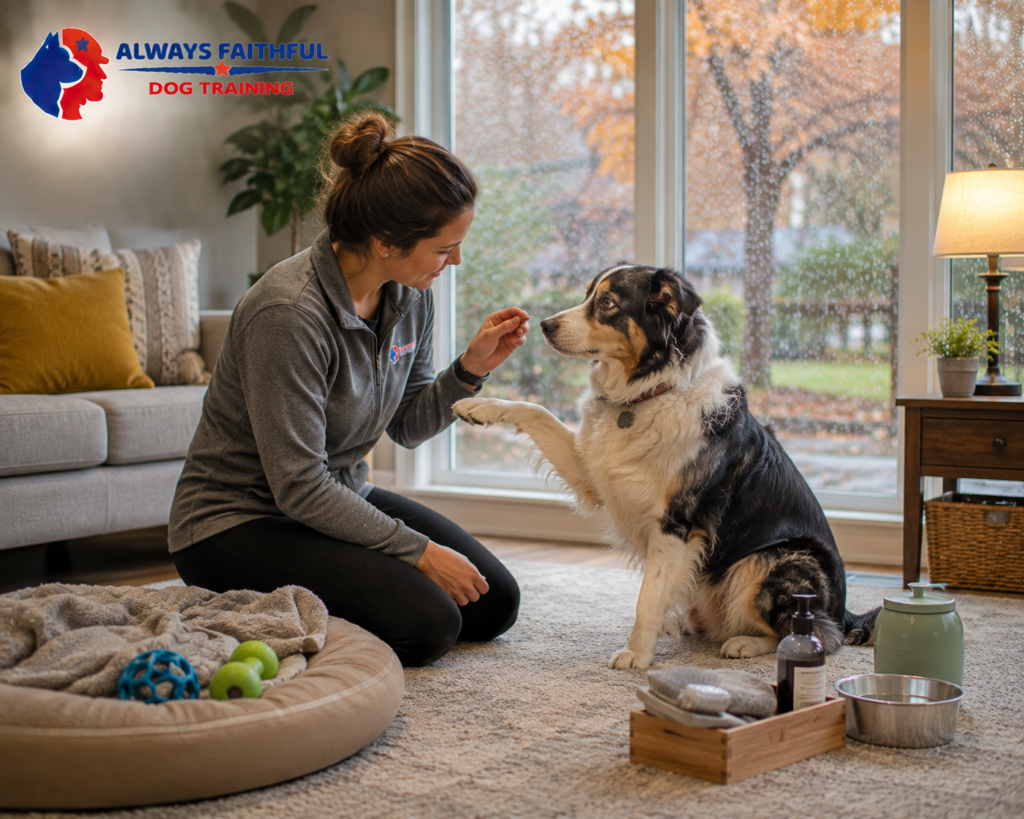
Waiting is a surprisingly important life skill for dogs. A dog may need to remain beside its owner while someone checks in at a reception desk, while an appointment is being prepared, or while another person finishes a conversation. These situations can be challenging because waiting areas often contain unfamiliar smells, footsteps, voices, doors, and other animals. A professional Dog Trainer can help dogs develop the ability to remain composed without constantly seeking stimulation. For owners searching for Dog training Near me, teaching calm waiting can be a practical part of preparing a dog for everyday public situations.
Why Waiting Requires Its Own Training
Walking calmly and waiting calmly are not exactly the same behavior. During a walk, a dog is moving and receiving continuous information from its surroundings. Waiting requires the dog to remain relatively settled while activity continues around it.
Some dogs become restless when movement stops. They may wander, pull toward interesting smells, vocalize, or repeatedly look for something to investigate.
Training gives the dog an alternative to constantly reacting to every event happening nearby.
Start Before Visiting a Busy Location
One of the easiest ways to introduce waiting is at home. Owners can create short periods where the dog remains in one appropriate location while normal household activity continues.
Someone might walk through the room, open a door, pick up an object, or sit nearby while the dog practices remaining settled.
The purpose is not to create a long endurance test. Short, successful sessions allow the dog to learn that nothing needs to happen simply because people are moving around.
Gradually Increase the Waiting Period
Duration should be developed progressively. A dog that can remain settled for one minute should not automatically be expected to wait calmly for half an hour.
Short sessions provide opportunities for success. As the dog becomes more comfortable, the waiting period can gradually become longer.
The owner should also vary the duration rather than making every session exactly the same. Real-life waiting rarely follows a predictable timer.
Teach the Dog Where to Settle
A clear physical location can make waiting easier to understand. Depending on the environment, this could be beside the owner’s chair, on a mat, or in another appropriate space.
The location acts as a visual reference for the dog. Instead of wandering around trying to decide where to go, the dog has a defined area in which to remain.
This can be particularly helpful in places where there is limited room for movement.
Introduce Mild Distractions First
A quiet room is easier than a busy public space. Owners can gradually introduce distractions such as someone walking past, a door opening, or another person sitting nearby.
The dog does not need to interact with every distraction. Learning to notice something without immediately responding to it is an important part of calm waiting.
As the dog’s ability improves, the level of activity can increase.
Reading the Difference Between Restlessness and Stress
Not every movement means the dog is simply impatient. Dogs can also become uncomfortable when surrounded by unfamiliar people, animals, or sounds.
Owners should watch the dog’s overall body language. Repeated attempts to escape, intense panting, freezing, trembling, or persistent avoidance may indicate that the environment is too difficult.
Training should not turn into a contest to see how long a dog can tolerate an uncomfortable situation. The environment may need to be simplified or the distance from a trigger increased.
Practicing Attention Without Constant Interaction
An important part of Dog training Near me can involve teaching dogs that being near their owners does not always mean receiving continuous attention. This distinction becomes useful in waiting rooms and other places where the owner may need to focus on paperwork, conversations, or appointments.
The dog can learn that the owner’s attention may come and go while the expectation to remain settled stays consistent.
This encourages a more independent form of calmness rather than requiring the owner to constantly entertain or redirect the dog.
Making Waiting Areas Less Novel
Dogs often struggle in public waiting spaces because everything is unfamiliar at once. The floor may smell different, people may move unpredictably, and other animals may be nearby.
When appropriate, owners can practice in gradually more stimulating environments before expecting the dog to handle a busy waiting area.
A quiet outdoor bench, calm building entrance, or low-traffic public space may provide an intermediate step between home and a highly stimulating location.
Handling Other Dogs Nearby
Another dog entering a waiting area can immediately change the situation. Even a normally calm dog may become interested, excited, nervous, or defensive.
Owners should not assume that every dog wants to interact. Maintaining appropriate distance can give both animals more room to remain comfortable.
Training should emphasize the owner’s communication rather than forcing greetings. A dog that can remain settled while another dog passes nearby has developed a useful public-life skill.
Why the Owner’s Behavior Matters
Dogs observe their owners closely. If the owner becomes tense, repeatedly pulls on the leash, or constantly changes instructions, the dog may receive unclear information.
Calm, consistent handling can make the situation easier to understand.
The owner’s preparation also matters. Having the dog’s equipment properly fitted, knowing where the dog can safely stand or sit, and avoiding unnecessarily crowded areas can reduce preventable difficulties.
Practicing With Realistic Household Scenarios
Owners can recreate simple waiting situations at home. One person can pretend to check in at a desk while another waits with the dog. Someone can sit down and have a conversation while the dog remains nearby.
These exercises introduce the idea that humans may become occupied while the dog is expected to remain composed.
Once the dog understands the pattern, the same concept can be practiced in increasingly realistic settings.
Avoid Making Every Waiting Session Extremely Long
Waiting training should not always involve prolonged stillness. Dogs also need appropriate movement, exploration, exercise, and interaction.
The objective is flexibility. A dog should be capable of relaxing when necessary while still having appropriate opportunities to move and engage.
Balanced routines can make calm waiting easier because the dog is not expected to remain inactive for unreasonable periods.
When Professional Assistance Can Be Useful
Some dogs have particularly strong reactions in public environments. They may bark continuously, lunge toward other animals, panic around unfamiliar people, or struggle to settle even after repeated practice.
In such cases, professional guidance can help identify the underlying difficulty. The solution may involve changing the distance from distractions, modifying the training environment, or developing a more gradual progression.
A professional can also help owners distinguish between ordinary restlessness and behavior that requires a more specialized approach.
Turning Waiting Into a Practical Life Skill
Calm waiting has applications far beyond appointments. Dogs may need to wait near a doorway, outside a store, during travel preparations, while family members finish an activity, or while someone handles an everyday task.
Each situation provides an opportunity to reinforce the broader concept that not every moment requires action.
A dog that understands this distinction can become easier to manage in situations where movement and interaction are temporarily limited.
Final Thoughts
Learning to wait calmly is not simply about making a dog sit still. It involves teaching the dog how to remain composed while unfamiliar people, sounds, animals, and activities continue nearby. A skilled Dog Trainer can help develop this ability through gradual exposure, clear expectations, appropriate waiting locations, and realistic practice. For owners looking into Dog training Near me, calm waiting is a valuable everyday skill that can help dogs navigate public spaces with greater structure and predictability.