
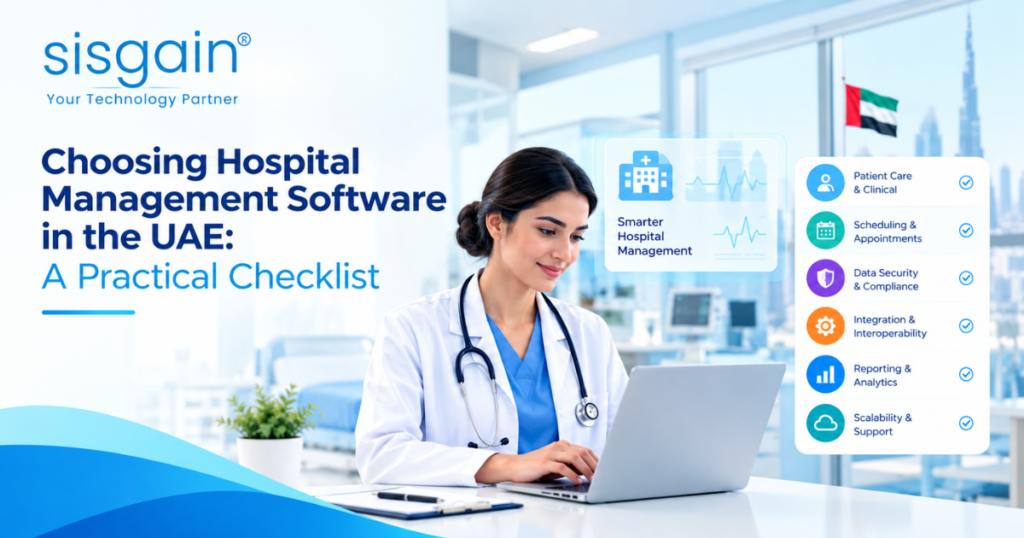
Selecting a hospital information platform is one of the most consequential technology decisions a healthcare provider will make. The system you choose shapes how clinicians document care, how quickly claims are paid, how safely patient data is protected and how easily the organisation can grow. A poor choice can mean years of workarounds, compliance exposure and frustrated staff.
The UAE adds its own layer of complexity. Providers operate under different emirate-level regulators, connect to multiple health information exchanges, and must meet strict health-data rules. This guide gives hospital owners, CIOs and administrators a practical checklist for evaluating options with confidence.
Why the Selection Process Deserves More Time Than Most Providers Give It
Many hospitals begin with a vendor demo and a price quote. That is the wrong starting point. The stronger approach starts with your own workflows, pain points and regulatory obligations, and only then moves to vendor comparison.
Before you speak to any supplier, gather input from clinicians, nurses, billing teams, front-desk staff, pharmacy, laboratory, radiology and IT. Each group sees different gaps. A system that impresses the medical director in a demo may still frustrate the billing office every day. Document what works today, what breaks, and what you expect the system to do in five years.
Start With the Core: Evaluating EHR Software UAE Providers Can Trust
At the heart of any hospital platform sits the electronic health record. When assessing EHR software UAE clinicians will use daily, look past the feature brochure and test real clinical workflows.
Key questions to ask:
- Does the record capture structured data for diagnoses, medications, allergies, vitals and lab results, rather than relying on free-text notes?
- Does it support standard coding systems such as ICD-10, CPT, SNOMED CT and LOINC where relevant?
- Can clinicians complete a typical consultation in a reasonable number of clicks?
- Does it support specialty-specific templates, for example for cardiology, paediatrics or obstetrics?
- Is the interface available in Arabic and English, and can patient-facing documents be produced in both?
- How does the system handle e-prescribing, order entry and results review?
Ask vendors to demonstrate these tasks live, using your own scenarios. Scripted demos hide weaknesses. A hospital that tests a realistic day-in-the-life workflow learns far more than one that watches a polished presentation.
Understanding the Market: Hospital Management Software UAE Buyers Will Compare
The market for hospital management software UAE providers can choose from ranges from global enterprise suites to regional platforms and specialist local products. Each category has trade-offs.
Global suites offer depth and a long product history but can be expensive and slower to adapt to local requirements. Regional and locally built platforms often come with built-in support for UAE regulators, insurers and e-claim systems, and may be easier to customise. Niche tools may excel in one area, such as radiology or pharmacy, but require integration to work as part of a larger ecosystem.
Match the category to your organisation’s size and ambition. A single-specialty clinic has very different needs from a multi-site hospital group. Resist paying for modules you will not use in the next two to three years, but make sure the platform can add them later without a painful migration.
What a Hospital Management System Dubai Facilities Need to Handle
Dubai has its own regulatory and operational landscape. A hospital management system Dubai providers adopt should align with Dubai Health Authority requirements, connect to the emirate’s health information exchange, and support the insurance and e-claim processes used locally.
Facilities in Dubai should confirm that the system supports:
- Integration with NABIDH, the emirate’s health information exchange
- DHA-compliant e-claim submission and insurer communication
- Dubai-specific reporting and licensing obligations
- Multi-language patient communication
- Support for medical tourism workflows, where relevant
Ask vendors for live references among Dubai providers of a similar size. A supplier that already operates successfully in the emirate will understand local expectations far better than one entering the market for the first time.
The Core Modules: A Functional Checklist
Beyond the EHR, a complete platform covers many operational areas. Use the list below to ensure nothing is missed.
Patient records and registration
- Unique patient identification, including Emirates ID support
- Fast registration with duplicate detection
- Consent management and document storage
- Complete patient history across visits and facilities
Scheduling and appointments
- Multi-resource scheduling for doctors, rooms and equipment
- Online and mobile booking
- Automated reminders by SMS, email or app notification
- Waitlist management and no-show tracking
Billing and revenue cycle
- Package pricing, self-pay and insurance billing
- Real-time eligibility checks and pre-authorisation support
- Electronic claim submission and denial management
- Reconciliation, aged-debtor reports and revenue analytics
Clinical departments
- Laboratory information system with analyser integration
- Radiology and PACS integration
- Pharmacy and inventory control
- Operating theatre, inpatient and emergency modules
Management and reporting
- Dashboards for occupancy, revenue, utilisation and quality indicators
- Customisable reports for regulators and internal governance
- Audit trails showing who accessed or changed what
Rate each vendor against these areas, and weight the scores by what matters most to your organisation.
Hospital Management System Requirements: Building Your Specification
Before issuing a request for proposal, write down your hospital management system requirements clearly. A vague requirement document leads to vague proposals and expensive change requests later.
A strong requirements document should cover:
- Functional requirements, meaning what each department needs the system to do
- Technical requirements, including hosting model, performance, availability and scalability
- Integration requirements, listing every system the platform must connect to
- Regulatory requirements, covering licensing, data residency, reporting and security standards
- Support and service requirements, such as response times, training and local presence
- Commercial requirements, including licensing model, implementation costs and exit terms
Separate “must have” from “nice to have”. This helps you compare proposals fairly and prevents a long wish list from inflating cost. Involve legal and compliance teams early so contractual terms reflect your regulatory duties.
Integration: The Make-or-Break Factor
No hospital system works in isolation. It must exchange data with laboratories, imaging devices, insurers, pharmacies, regulators and national exchanges. Weak integration creates duplicate data entry, errors and delays.
When assessing healthcare software integration UAE providers should examine the following:
- Standards support. Does the platform support HL7 v2, FHIR APIs and DICOM, and does the vendor publish API documentation?
- National and regional exchanges. Is the system already connected to Malaffi in Abu Dhabi, NABIDH in Dubai, or Riayati for facilities under the Ministry of Health and Prevention, as applicable to your location?
- Insurance and e-claim platforms. Does it integrate with the e-claim systems used by your regulator, such as Shafafiya in Abu Dhabi or eClaimLink in Dubai?
- Devices and equipment. Can it connect to lab analysers, imaging modalities and bedside monitoring?
- Third-party applications. Can patient apps, telemedicine tools and analytics platforms connect through open APIs?
Ask the vendor who is responsible for building and maintaining each integration, how much it costs and how long it takes. Integration is often where projects exceed budget, so clarity here protects you.
Data Security and Compliance With UAE Health-Data Requirements
Health data is among the most sensitive information an organisation holds, and UAE rules reflect this. Federal law on the use of information and communications technology in health fields places obligations on how health data is stored, transferred and protected, including restrictions on moving data outside the country except in defined circumstances. The federal personal data protection law and emirate-level policies add further requirements. Abu Dhabi providers also work to the Department of Health’s information security standard, and Dubai providers follow Dubai Health Authority policies on data protection and confidentiality.
Because regulations evolve, always confirm current requirements with your regulator and legal adviser. In your evaluation, test the following:
- Data residency. Where is data hosted, and can the vendor guarantee in-country storage where required?
- Access control. Does the system offer role-based access, strong authentication and the ability to restrict sensitive records?
- Encryption. Is data encrypted at rest and in transit?
- Audit logging. Can you trace every access, edit and export of a patient record?
- Breach response. Does the vendor have a documented incident response plan and clear notification procedures?
- Backup and disaster recovery. What are the recovery time and recovery point objectives, and are they tested?
- Certifications and testing. Does the vendor hold recognised security certifications and undergo regular penetration testing?
- Subcontractors. Who else touches your data, and under what safeguards?
Request evidence rather than assurances. Ask for audit reports, certificates and sample policies, and involve your information security team in the review.
Comparing Hospital Management Software Providers UAE Organisations Shortlist
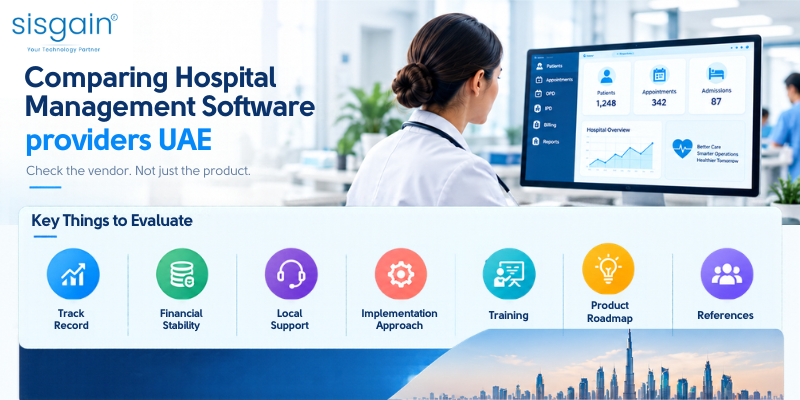
When you compare hospital management software providers UAE has available, evaluate the vendor as carefully as the product. Software is a long relationship, not a one-off purchase.
Look at:
- Track record. How many UAE hospitals use the platform, and for how long?
- Financial stability. Will the vendor still be here in ten years?
- Local support. Is there a team in the UAE, available in your working hours and language?
- Implementation approach. What methodology, timeline and team will they bring?
- Training. How will staff be trained, and what ongoing learning resources exist?
- Product roadmap. Is the vendor investing in areas such as AI, mobile and interoperability?
- References. Can you speak to existing customers without the vendor present?
Visit a live site if possible. Seeing the system used by real staff in a real hospital tells you more than any proposal.
Hospital Administration Software: Looking Beyond the Clinical Side
Clinical features get the most attention, but hospital administration software carries much of the operational load. Human resources, rostering, procurement, inventory, finance, asset management and facilities all affect how smoothly a hospital runs.
Check whether these functions come within the same platform or need separate tools. Integrated administration modules reduce duplicate data entry and give managers a single view of cost and performance. If you plan to use separate administrative systems, confirm that they integrate cleanly with the clinical platform. Strong administrative tools also support the kind of data-driven planning discussed in our guide on How AI Is Transforming Hospital Management in the UAE, where cleaner operational data improves patient-flow forecasting and predictive analytics.
Healthcare Management Software and the Wider Digital Ecosystem
Modern providers are moving beyond a single monolithic system. Healthcare management software now sits within a wider ecosystem that includes patient portals, telemedicine, remote monitoring, analytics and mobile apps. When selecting a core platform, ask how easily it can connect to these extensions.
A platform with open APIs and a modular design gives you freedom to add capabilities over time. A closed system may look attractive at first but can limit innovation and lock you into one vendor’s roadmap. Think about where your organisation wants to be in five years, and choose a foundation that can support that direction.
When Custom Development Makes Sense
Off-the-shelf products cover most standard needs, but some organisation have workflows, patient journeys or business models that generic software cannot support. In these cases, working with a healthcare app development company in Dubai allows you to build tailored modules that sit on top of, or alongside, your core system.
Typical examples include branded patient apps, clinician mobile tools, specialty workflow modules and custom dashboards. Engaging healthcare app development Dubai specialists is most effective when you have already defined the problem and the integration points. A good partner will understand UAE regulation, health-data rules and the practical realities of connecting to hospital systems, and will build in security and compliance from the start rather than adding it afterwards.
Cost, Contracts and Total Cost of Ownership
The licence fee is only part of the cost. When comparing proposals, build a total cost of ownership view over five years that includes:
- Licences or subscriptions
- Implementation and data migration
- Integration development
- Hardware, networking and hosting
- Training and change management
- Support, maintenance and upgrades
- Customisation and future module costs
- Costs of exiting the contract and extracting your data
Pay particular attention to contract terms. Clarify who owns the data, how it can be exported if you leave, what service levels are guaranteed and what penalties apply if they are missed. A cheaper proposal with hidden extras often costs more than a transparent one.
Implementation and Change Management
Even the best software fails if the rollout is poorly managed. Plan for the human side of the project as carefully as the technical side.
- Appoint clinical champions who can advocate for the system and give peers practical help.
- Clean and migrate data carefully, testing with real records before go-live.
- Train in role-specific groups, using realistic scenarios rather than generic slides.
- Run a pilot in one department or site before full rollout where possible.
- Plan go-live support, with extra staff available on the floor in the first weeks.
- Measure results, tracking registration time, claim rejection rates, waiting times and user satisfaction.
Set realistic expectations. Productivity often dips briefly after go-live before improving. Clear communication helps staff stay patient through that period.
The Final Evaluation Checklist
Use this condensed list when scoring your shortlisted vendors.
- Does the EHR support structured, specialty-ready clinical documentation?
- Does the system meet your regulator’s requirements for the emirate in which you operate?
- Is it connected to the relevant health information exchange and e-claim platform?
- Does it cover registration, scheduling, billing, laboratory, radiology and pharmacy?
- Are APIs and standards such as HL7 and FHIR supported and documented?
- Is data hosted and protected in line with UAE health-data rules?
- Are access controls, encryption and audit trails robust?
- Does the vendor have local references, local support and a credible roadmap?
- Is the total cost of ownership clear, with fair exit and data-ownership terms?
- Can the platform scale and connect to future apps, analytics and AI tools?
A vendor that scores well across all ten is likely to be a sound long-term partner.
Conclusion
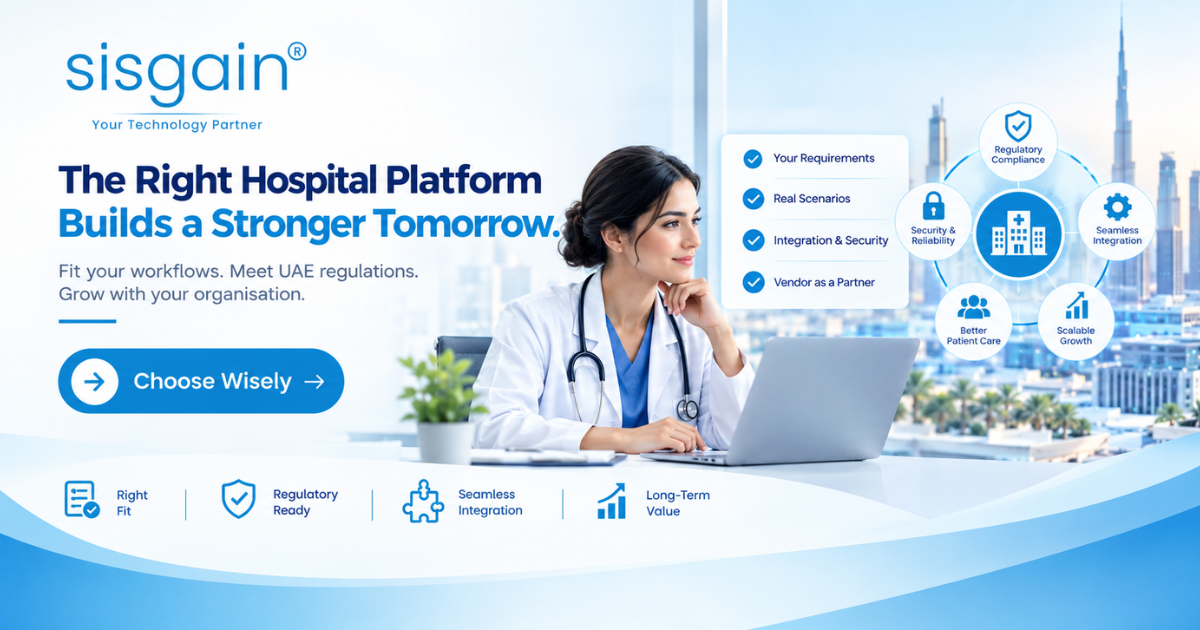
Choosing the right hospital platform is less about finding the system with the longest feature list and more about finding the one that fits your workflows, satisfies UAE regulation and grows with your organisation. Start with your own requirements, test real scenarios, scrutinise integration and security, and evaluate the vendor as a long-term partner. Providers that follow a disciplined, checklist-driven process make better decisions, avoid costly surprises and build a digital foundation that supports safer, more efficient patient care for years to come.