
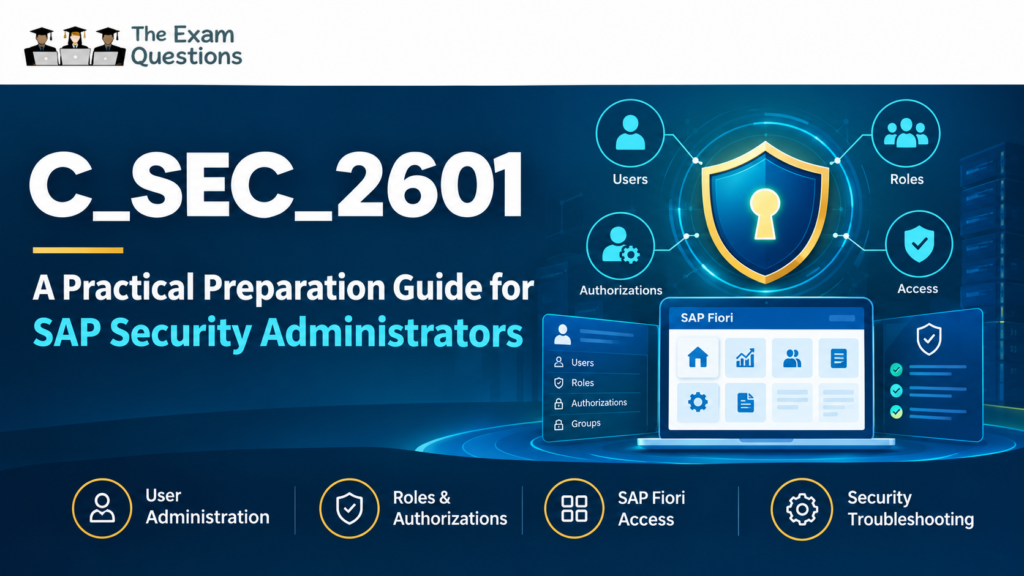
SAP security administration means giving people the access they need while protecting business data and keeping work moving. If you are preparing for C_SEC_2601, you need to know how authorization concepts work in practice, because memorized definitions will not carry you through a system-based task.
The exam page above shows the practical practice format on offer. Build your revision plan around what you will have to explain, configure, and verify.
What does the C_SEC_2601 certification assess?
SAP describes the Security Administrator certification as validating core knowledge of SAP system security and authorizations for SAP S/4HANA Public Edition and Private Edition. It also covers the ability to apply that knowledge as part of a project or security team.
The topics are closely linked:
- User administration covers how accounts are maintained and assigned suitable access.
- Roles and authorizations cover how permissions map to job responsibilities and why access should follow least privilege.
- SAP Fiori access covers how business roles and app permissions decide which applications a user can open.
- Identity and provisioning covers what identity services do and how identities or access assignments move between connected systems.
- Security analysis means investigating an access problem before you change any configuration.
Take an employee who signs in successfully but cannot open an app or complete a transaction. Authentication confirms who the person is, and authorization decides what they can do. A security administrator has to find the layer where the problem sits, and a password reset will not fix every access issue.
Know the current C_SEC_2601 exam format
SAP currently describes the Security Administrator assessment as one system-based activity lasting three hours, with a 74% pass score. The certification page lists English as the only available language. SAP labels the certification code C_SEC, while exam-preparation pages commonly call this version C_SEC_2601.
The SAP official certification page lists current requirements, technical setup, and recommended preparation topics. A system-based assessment rewards hands-on familiarity: read the task carefully, make controlled changes, and confirm the result.
Reading a solution helps you recognize a concept, but only completing the task yourself shows whether you know the sequence. Use SAP’s exam information to confirm requirements, and use practice exercises to build speed and accuracy.
Build a practical study plan
Short, structured sessions work better than one long attempt to cover everything. Adjust the timeline to your experience, and make sure it includes active practice.
Check your starting point
Test yourself on role assignment, authorization logic, user access, SAP Fiori authorizations, and identity provisioning. Mark each topic as confident, needs revision, or needs hands-on practice, so every session has a clear purpose.
Learn the reason behind each task
Understand why a configuration step is needed before you memorize where to click. Role-based access should reflect job duties and follow least privilege. Broad access may make a task work quickly, but it adds risk. Knowing the business reason for an authorization decision helps you pick the safer solution.
Practice and repeat
Use a practice system or guided environment. Focus on the goal of each task, the steps you took, and how you confirmed the result. With guided questions, attempt the task before you reveal the solution, then close the explanation and repeat the activity from memory.
Keep an error log
For each mistake, record the assumption behind it, the correct reasoning, and the check that would have caught it. Group recurring problems by theme, such as role selection, access troubleshooting, or identity services. Spend your review time on this log and not on tasks you already get right.
Add timed practice
Once the main concepts are clear, complete tasks against the clock. Afterward, review both accuracy and process. Did you understand the requirement? Did you make unnecessary changes? Did you verify the outcome? Aim for calm, consistent execution, and avoid rushed clicking.
Learn to troubleshoot as well as configure
A strong security administrator follows the evidence. When a user reports an access problem, pin down the exact symptom and the task they need to complete. Check whether the user can sign in, whether the application is visible, and at what point the failure occurs.
Then compare the role and authorization assignments with the user’s responsibilities. For a Fiori issue, look at the business role and app access involved. For an identity-provisioning issue, check whether identity data or assignments reached the intended system. Make one controlled change at a time and retest the original scenario.
This method cuts down on guesswork and supports auditability. It also stops you from granting excessive permissions just to make an error message disappear.
Common preparation mistakes
- Memorizing without practicing. A system-based assessment tests applied understanding.
- Relying on outdated exam details. Older articles may describe a different format, so confirm the latest requirements with SAP.
- Ignoring access design. Broad permissions can make a task work while creating a security concern.
- Reading answers without repeating the tasks. Recognizing an explanation does not show you can perform the steps on your own.
- Leaving setup checks too late. Confirm your device, connectivity, SAP Universal ID, subscription, and attempt information well in advance.
Final checklist before exam day
Review your error log and repeat the tasks that exposed gaps. Go back over user accounts, roles and authorizations, SAP Fiori access, identity services, and troubleshooting, and explain the reason for each configuration choice in plain language.
Check SAP’s certification page for current exam instructions and sort out the required setup early. During the assessment, read each task carefully and leave time to validate the outcome.
Conclusion: prepare for C_SEC_2601 with practical understanding
Preparing for C_SEC_2601 builds skills you use in day-to-day SAP security administration. Study roles and authorizations, practice realistic tasks, review your mistakes, and verify every change. Treat SAP’s certification page as the source for current exam requirements, and use practice materials to find your gaps.
For more SAP exam preparation content, visit The Exam Questions and pick practice that explains the reasoning behind each task.
Frequently asked questions
Is C_SEC_2601 a multiple-choice exam?
No. SAP currently describes the Security Administrator assessment as a system-based exam with one activity. Practice the relevant tasks and learn to verify your work, because multiple-choice drills alone will not prepare you.
How long is the C_SEC_2601 assessment?
SAP currently lists a three-hour duration and a 74% pass score. Check the official certification page before exam day in case the requirements change.
What should I study for C_SEC_2601?
Cover SAP security fundamentals, user accounts, roles and authorizations, SAP Fiori access, identity and provisioning concepts, and access troubleshooting. Let SAP’s current certification information guide your revision.
How can practice questions help with C_SEC_2601?
Practice tasks let you apply concepts, find gaps, and improve your task sequence. Attempt each question on your own, review the reasoning, then repeat it without the solution.