

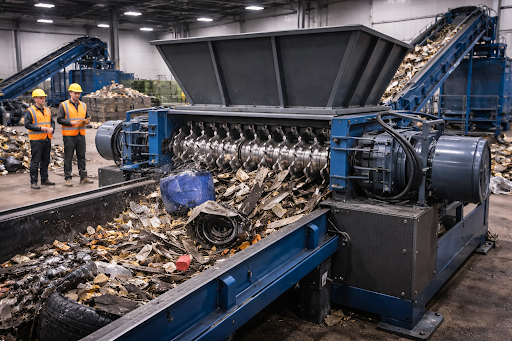
Industrial waste management has become increasingly important as businesses handle larger volumes of materials and stricter environmental regulations continue to evolve. Manufacturing facilities, recycling plants, warehouses, and construction operations all generate waste that must be processed efficiently to reduce costs and improve sustainability.
One of the most effective technologies used in waste processing today is the industrial shredder. These heavy-duty machines are designed to reduce large materials into smaller, manageable pieces, making transportation, recycling, and disposal more efficient. Industrial shredders play a critical role in improving recycling operations, reducing landfill waste, and supporting environmentally responsible waste management practices across multiple industries.
What Is an Industrial Shredder?
An industrial shredder is a powerful machine specifically designed to break down bulky or dense materials into smaller fragments. Unlike standard shredders used for paper or office applications, industrial shredders are engineered to continuously process high volumes of heavy materials.
A modern industrial shredder can handle a wide variety of waste materials, including plastics, metal scrap, wood, rubber, paper, textiles, construction debris, and electronic waste. These machines use rotating cutting shafts equipped with sharp blades that tear, shear, or compress materials during processing.
Reducing Waste Volume Efficiently
One of the biggest advantages of using an industrial shredder is the reduction in waste volume. Large waste materials can occupy significant storage space and increase transportation costs when left unprocessed.
By using an industrial shredder, businesses can substantially reduce the size of waste materials, allowing for more efficient storage and transport. Smaller waste particles are easier to compact, load into containers, and transport to recycling or disposal facilities.
Supporting Recycling Operations
Recycling systems depend heavily on shredding technology to prepare materials for sorting and recovery. Materials such as plastic, aluminium, steel, cardboard, and electronic components often require size reduction before entering separation systems.
An industrial shredder improves recycling efficiency by creating consistent material sizes that can move more effectively through conveyors, sorting systems, and magnetic separators. Shredding also helps expose valuable recyclable materials hidden within mixed waste streams.
Industries focused on sustainability often rely on shredders to increase recycling rates and reduce dependency on landfills.
Improving Workplace Efficiency
Industrial facilities that generate large amounts of waste can quickly become disorganised if waste handling systems are inefficient. Accumulated waste not only reduces workspace efficiency but may also create operational delays and safety concerns.
Using an industrial shredder helps businesses streamline waste handling by processing materials directly on-site. Employees spend less time managing bulky waste, and production areas remain cleaner and more organised.
Enhancing Environmental Sustainability
Sustainability has become a major priority for businesses across nearly every industry. Companies are increasingly expected to reduce landfill waste, improve recycling rates, and adopt environmentally responsible waste management strategies.
An industrial shredder supports sustainability initiatives by reducing waste size and improving the recovery of reusable materials. Recycled metals, plastics, and paper products can often be reintroduced into manufacturing processes, helping conserve natural resources and reduce environmental impact.
Shredding systems also contribute to cleaner waste handling practices by minimising unmanaged waste accumulation and supporting more efficient material separation.
Lowering Disposal and Transportation Costs
Waste disposal costs continue to increase due to rising landfill fees, environmental regulations, and transportation expenses. Businesses handling bulky waste often incur higher operational costs when waste is not processed efficiently.
An industrial shredder helps reduce these expenses by decreasing waste volume before transportation. Smaller waste particles allow businesses to maximise container space and reduce the frequency of hauls.
Conclusion
As industries continue to focus on automation and efficient waste handling, additional equipment, such as a garbage compactor, can further enhance waste management systems by improving storage efficiency and simplifying waste transportation.
Industrial shredders continue to play a major role in modern waste management by improving recycling efficiency, reducing waste volume, lowering transportation costs, and supporting environmental sustainability. Their ability to process a wide range of materials makes them essential equipment across multiple industrial sectors.
