

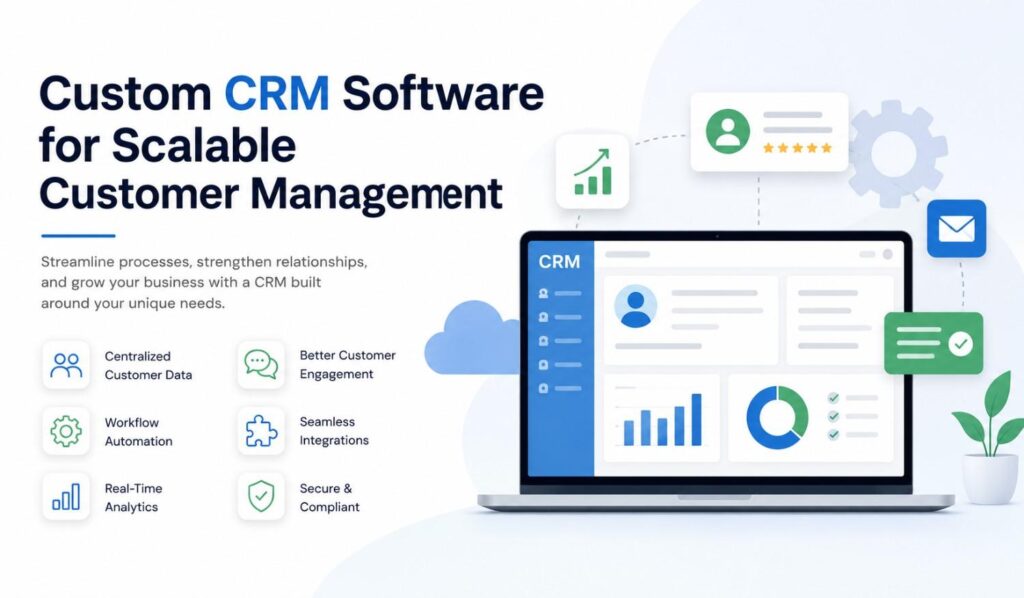
Growth is exciting—until customer information starts living in spreadsheets, inboxes, sticky notes, and that mysterious document nobody remembers creating. As businesses expand, managing customer relationships becomes increasingly complex. More leads arrive, more conversations happen, and more data needs attention. Suddenly, what once felt organized begins resembling a digital junk drawer.
That is where custom CRM software enters the picture. Rather than forcing businesses to adapt to rigid systems, a tailored solution grows alongside operations and supports unique processes. Over the years, we have observed that scalable customer management rarely happens by accident. It happens when the right technology creates structure, visibility, and efficiency. Let us explore how custom CRM software makes that possible.
Understanding Scalability in Customer Management
Scalability in customer management means handling increasing numbers of customers, interactions, and data without sacrificing service quality or operational efficiency. Many businesses start with simple tools that work perfectly well during the early stages. However, as customer bases grow, those same tools often become obstacles rather than assets.
Managing hundreds or thousands of customer interactions requires more than good intentions. Teams need systems capable of organizing information, automating repetitive tasks, and providing quick access to meaningful insights. Without scalable processes, growth can create confusion instead of opportunity. Customer expectations continue rising, and businesses need technology that keeps pace without creating additional complexity.
Why One-Size-Fits-All CRM Platforms Often Reach Their Limits
Off-the-shelf CRM platforms can provide a helpful starting point, but many businesses eventually discover their limitations. Generic systems are designed to serve a broad audience, which often means they include features that go unused while lacking functionality that specific organizations genuinely need.
As operations evolve, teams frequently resort to spreadsheets, manual workarounds, and disconnected tools to fill those gaps. Ironically, software intended to simplify processes can sometimes create additional layers of complexity. We once encountered a business using six separate spreadsheets to compensate for CRM limitations. At that point, the spreadsheets practically deserved employee badges. Custom CRM software eliminates these inefficiencies by aligning technology with actual business requirements.
How Custom CRM Software Supports Business Growth
Custom CRM software supports growth by adapting to business needs instead of forcing businesses to change established workflows. Every organization operates differently, and customer management processes often reflect years of refinement and industry expertise. A tailored CRM preserves those advantages while improving efficiency.
As customer volumes increase, custom solutions can accommodate new workflows, additional users, and evolving business objectives. Whether expanding into new markets or introducing new services, the system can be enhanced without disrupting existing operations. This flexibility allows organizations to focus on growth initiatives rather than constantly adjusting their processes to fit software limitations.
Centralized Customer Data Improves Scalability
One of the greatest challenges growing businesses face is fragmented customer information. Data scattered across multiple platforms creates delays, inconsistencies, and unnecessary frustration. A custom CRM establishes a centralized environment where customer details, communication history, transactions, and interactions are stored in a single location.
Centralization improves visibility across departments and reduces the likelihood of duplicated efforts. Sales teams can access updated information, customer support representatives can view interaction histories, and management can gain a complete picture of customer relationships. When everyone works from the same source of truth, scaling operations becomes significantly more manageable and far less chaotic.
Automation Makes Growth More Manageable
Growth often brings an increase in repetitive tasks. Lead assignments, follow-up reminders, status updates, and customer communications can quickly consume valuable employee time. Custom CRM software addresses this challenge through automation, allowing teams to focus on meaningful customer interactions rather than administrative work.
Automated workflows ensure that critical activities happen consistently and on schedule. Leads can be routed automatically to the appropriate team members, reminders can be generated without manual intervention, and notifications can keep projects moving forward. As customer volumes increase, automation prevents operational bottlenecks from slowing growth. In many ways, automation acts like an extra team member—one that never forgets a task and never requests a coffee break.
Custom CRM Software Enhances Customer Experiences at Scale
Customers expect personalized experiences regardless of how large a company becomes. Maintaining that level of attention can be difficult when customer numbers grow rapidly. Custom CRM software helps businesses deliver consistent and personalized interactions by providing quick access to customer histories, preferences, and previous communications.
Instead of treating every interaction as a new conversation, employees can approach customers with context and understanding. Faster responses, more relevant recommendations, and smoother support experiences contribute to stronger relationships. As customer expectations continue to evolve, scalable customer management depends on maintaining a personal touch—even when thousands of customers are involved. The right CRM helps make that possible without overwhelming internal teams.
Integration Capabilities Create a Connected Business Ecosystem
Modern businesses rarely operate using a single software platform. Sales, marketing, accounting, customer service, and operations often rely on multiple systems working together. Custom CRM software serves as a central hub that connects these applications and creates a more unified workflow.
Integration eliminates the need for employees to switch constantly between platforms or manually transfer data. Customer information can flow seamlessly between departments, reducing errors and improving efficiency. Whether connecting with ERP systems, marketing automation tools, accounting platforms, or communication applications, a customized CRM creates a connected ecosystem that supports growth. After all, business software should behave like a coordinated team—not distant relatives meeting for the first time at a family gathering.
Real-Time Reporting Supports Smarter Scaling Decisions
Business growth requires informed decision-making. Without accurate data, leaders often rely on assumptions that may not reflect reality. Custom CRM software provides real-time reporting and analytics that help organizations understand performance, identify trends, and uncover opportunities for improvement.
Custom dashboards can display the metrics that matter most to specific business objectives. Sales performance, customer retention, lead conversion rates, and service response times become easier to monitor and analyze. Access to timely insights allows businesses to respond proactively rather than reactively. As organizations scale, informed decisions become increasingly important, and real-time visibility provides a significant competitive advantage.
Security and Compliance Remain Strong During Expansion
Customer data is one of the most valuable assets a business possesses. As organizations grow, protecting that information becomes increasingly important. Custom CRM software can be designed with security measures tailored to specific operational and regulatory requirements.
Role-based access controls help ensure that employees only access information relevant to their responsibilities. Audit trails, encryption protocols, and compliance-focused features strengthen data protection efforts. Growth should never come at the expense of customer trust. A scalable CRM solution helps businesses maintain security standards while supporting expansion. Strong security practices may not generate excitement during team meetings, but they certainly become memorable when they are missing.
A Practical Observation from Growing Businesses
Several growing organizations share a remarkably similar story. Operations begin with simple systems, customer numbers increase, and eventually information becomes scattered across emails, spreadsheets, and disconnected software tools. Productivity declines, reporting becomes difficult, and customer experiences start to suffer.
One business we worked with faced precisely this challenge. Their team spent more time searching for customer information than acting on it. After implementing a custom CRM solution, visibility improved dramatically, workflows became more efficient, and customer interactions became easier to manage. Growth did not suddenly become effortless, but it became significantly more organized. Sometimes the biggest productivity breakthrough is simply knowing where information lives.
Choosing the Right CRM Development Strategy
Implementing custom CRM software begins with understanding both current challenges and future goals. Businesses often focus on immediate pain points, but scalable solutions require a longer-term perspective. A CRM should support not only today’s operations but also tomorrow’s opportunities and growth initiatives.
Careful planning helps identify workflow requirements, integration needs, reporting expectations, and future scalability objectives. Partnering with an experienced CRM software development company can make a substantial difference throughout this process. The right solution balances flexibility, usability, and long-term performance. Growth strategies change over time, and customer management systems should be capable of evolving right alongside them rather than becoming obstacles.
Future Trends in Scalable Customer Management
Customer management technology continues to evolve at an impressive pace. Artificial intelligence, predictive analytics, and advanced automation are transforming how businesses understand and engage with customers. Custom CRM platforms are uniquely positioned to incorporate these innovations because they can be adapted to changing business needs.
Future systems will likely provide deeper customer insights, more accurate forecasting, and increasingly personalized experiences. Omnichannel communication capabilities will become even more important as customers interact through multiple platforms. Businesses that invest in flexible CRM solutions today will be better prepared for tomorrow’s technological advancements. The future rarely sends a calendar invitation before arriving, which makes preparation a valuable competitive advantage.
Conclusion
Scalable customer management requires more than hard work and good intentions. As customer bases grow, businesses need systems capable of organizing information, streamlining operations, and supporting increasingly complex workflows. Custom CRM software provides the flexibility and control necessary to meet those demands while maintaining excellent customer experiences.
From centralized data management and workflow automation to seamless integrations and real-time reporting, a tailored CRM creates a strong foundation for sustainable growth. We have seen businesses transform operational challenges into growth opportunities simply by implementing technology designed around their unique requirements. Growth tends to reward preparation, and a well-designed CRM ensures businesses are ready when the next opportunity arrives. After all, scaling customer relationships should feel like progress—not an extreme sport.
Frequently Asked Questions
1. What makes custom CRM software more scalable than off-the-shelf CRM systems?
Custom CRM software is built around specific business processes and growth objectives. Unlike generic platforms that often require workarounds, custom solutions can be expanded as customer volumes, workflows, and operational requirements increase. New features, integrations, and automation capabilities can be added without disrupting existing processes. This flexibility allows businesses to scale efficiently while maintaining productivity and customer satisfaction. A tailored system evolves alongside the organization, making it a long-term solution rather than a temporary fix.
2. How can a crm developer improve customer management processes?
A skilled CRM developer creates solutions that align technology with business objectives. This includes designing automated workflows, improving customer data organization, integrating third-party applications, and creating customized reporting dashboards. By removing manual processes and reducing inefficiencies, businesses can manage customer relationships more effectively. The developer also ensures that the CRM supports future growth and operational changes. Instead of forcing teams to adapt to software limitations, the software is designed to support how the business actually operates.
3. Is custom CRM software suitable for small businesses?
Absolutely. Small businesses often benefit significantly from custom CRM software because it allows them to start with essential features and expand functionality over time. Rather than paying for unnecessary tools included in large enterprise platforms, businesses can invest in capabilities that directly support their goals. As customer numbers grow and operational complexity increases, additional features can be added. This approach creates a cost-effective path toward scalability while maintaining a streamlined and user-friendly experience for employees.
4. How does CRM automation support scalability?
Automation reduces the time employees spend on repetitive administrative tasks. Activities such as lead assignment, follow-up scheduling, task creation, customer notifications, and workflow updates can occur automatically within the CRM system. As customer interactions increase, automation ensures consistency without requiring additional manual effort. Teams can focus more on relationship-building and strategic initiatives rather than routine processes. This increased efficiency allows businesses to serve more customers while maintaining quality service levels and operational control.
5. Can custom CRM software integrate with existing business applications?
Yes. One of the major advantages of custom CRM software is its ability to integrate with existing business tools. These integrations may include ERP systems, accounting platforms, email marketing solutions, communication tools, customer support software, and eCommerce applications. Seamless integration improves data accuracy, reduces duplicate work, and creates a more connected business environment. Employees gain access to relevant information from multiple systems without switching between applications, resulting in better productivity and decision-making.
6. How does custom CRM software improve customer experiences?
Custom CRM software provides teams with a complete view of each customer relationship. Access to communication histories, preferences, purchase records, and support interactions allows employees to deliver more personalized service. Faster response times and better-informed conversations help create positive customer experiences. Consistency across departments also improves because everyone works from the same information source. As businesses grow, maintaining this level of personalization becomes increasingly important for customer retention and long-term loyalty.
7. Which industries benefit the most from scalable CRM solutions?
Nearly every industry can benefit from scalable CRM solutions. Healthcare providers, manufacturing companies, real estate firms, financial organizations, educational institutions, professional service providers, and eCommerce businesses all rely heavily on customer relationship management. Each industry has unique requirements, which is why customization is often valuable. A CRM designed around industry-specific workflows improves efficiency, visibility, and customer engagement. Organizations experiencing rapid growth typically see particularly strong benefits from scalable customer management systems.
8. When should a business invest in custom CRM software?
Businesses should consider custom CRM software when existing systems begin creating inefficiencies or limiting growth. Common signs include fragmented customer data, excessive manual processes, reporting challenges, poor integration capabilities, and declining productivity. Waiting until operational issues become severe often makes the transition more difficult. Investing early allows organizations to establish scalable processes before growth creates larger complications. A proactive approach helps businesses remain organized, efficient, and prepared for future opportunities.
