

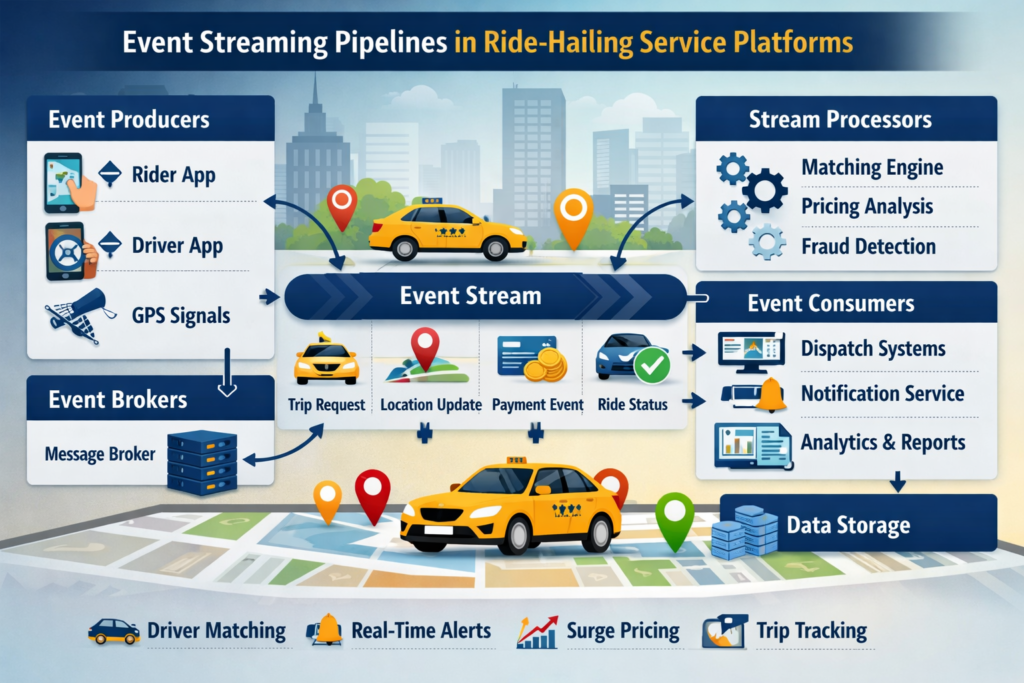
Event streaming pipelines play a crucial role in modern ride-hailing platforms where thousands of actions occur every second. Every driver location update, rider request, route calculation, and payment event generates continuous streams of data that must be processed instantly. Efficient event-driven architectures allow mobility platforms to maintain reliability, scalability, and real-time responsiveness. For engineers and planners working with a taxi booking app development company, understanding how event streaming pipelines function is essential for building systems that can handle high concurrency while maintaining smooth and responsive user experiences.
Understanding Event Streaming in Modern Ride-Hailing Platforms
Ride-hailing platforms operate in an environment where real-time responsiveness determines user satisfaction. Event streaming is a system architecture approach where every action in the platform generates an event that flows through a pipeline and is processed by different services.
Examples of events generated in mobility platforms include:
- Rider requesting a trip
- Driver accepting a ride
- GPS location updates from vehicles
- Trip start and trip completion signals
- Payment confirmations
Instead of processing these events sequentially in a monolithic application, modern systems distribute them across streaming pipelines. These pipelines allow multiple services to consume the same event simultaneously, enabling features such as real-time dispatch, fraud detection, analytics, and pricing adjustments.
For engineers working within a taxi booking app development company, event streaming provides a foundation for scalable and resilient infrastructure capable of supporting thousands or even millions of concurrent ride transactions.
Why Real-Time Data Pipelines Power Modern Mobility Applications
Mobility platforms depend heavily on instant decision-making. When a rider books a trip, the platform must immediately identify nearby drivers, calculate estimated arrival times, determine surge pricing, and notify available drivers.
Real-time pipelines allow this process to occur within milliseconds.
Traditional request-response systems struggle with high concurrency. Event streaming systems, however, process data continuously and distribute workloads across independent services.
Key advantages of real-time streaming pipelines include:
- Low latency processing
Events are processed immediately after they occur, enabling instant platform responses. - High scalability
Streaming systems can process millions of events per second using distributed infrastructure. - Fault isolation
If one service fails, the rest of the system continues functioning without interruption. - Parallel data consumption
Multiple services such as analytics engines and dispatch systems can read the same data stream simultaneously.
These capabilities are particularly important for organizations planning to build a ride sharing app that must scale across cities and regions while maintaining performance stability.
Core Components of Scalable Event Streaming Architecture Platforms
Event streaming pipelines consist of several core architectural components that work together to manage continuous data flow.
The most common components include the following.
Event Producers
Producers generate events. In ride-hailing platforms, these include:
- Rider mobile applications
- Driver mobile applications
- GPS tracking systems
- Payment processing services
Event Brokers
Brokers act as intermediaries that receive, store, and distribute events to consumers.
Stream Processors
These services analyze and transform event data in real time. They perform tasks such as:
- Driver matching algorithms
- Dynamic pricing calculations
- Trip monitoring and safety checks
Event Consumers
Consumers subscribe to event streams and perform actions based on incoming data. Examples include:
- Dispatch systems
- Notification services
- Analytics platforms
- Fraud detection engines
Data Storage Systems
Event logs and processed data are stored in distributed databases for reporting, auditing, and machine learning models.
Understanding these components helps architects working with a taxi booking app development company design infrastructure that supports high availability and system resilience.
How Driver Rider Matching Uses Continuous Event Streams Data
One of the most critical processes in ride-hailing platforms is driver-rider matching. Event streaming enables this process to operate efficiently in real time.
When a rider submits a trip request, the following event pipeline typically occurs.
- Trip request event generation
The rider application generates a booking event containing pickup location, destination, and ride preferences. - Location stream processing
The system continuously processes driver GPS updates from thousands of active vehicles. - Matching algorithm execution
A dispatch service consumes both streams and calculates the most suitable driver based on proximity, driver rating, and estimated arrival time. - Driver notification
Once the system identifies a driver, a new event triggers the notification system. - Ride acceptance confirmation
If the driver accepts, another event confirms the match and begins trip tracking.
Streaming pipelines make this process extremely fast because each event moves through multiple services simultaneously rather than waiting for sequential processing.
Role of Message Brokers in High Volume Mobility Systems Scale
Message brokers are the backbone of event streaming pipelines. They manage the movement of events between producers and consumers while maintaining reliability and order.
Popular broker technologies used in mobility platforms support:
- Distributed storage of event logs
- Fault tolerance through replication
- High throughput event processing
- Stream partitioning for scalability
Brokers divide event streams into partitions so multiple consumers can process data in parallel. This architecture allows systems to scale horizontally as user demand grows.
In high-volume mobility environments, brokers also provide durability. Events are stored for a configurable period, allowing services to replay streams when needed for debugging or system recovery.
When infrastructure planning occurs within a taxi booking app development company, selecting an appropriate message broker and configuring it correctly becomes a central architectural decision.
Designing Fault Tolerant Streaming Pipelines for Taxi Apps Platforms
Fault tolerance is essential for any mobility platform because downtime directly impacts both riders and drivers. Event streaming architectures address this challenge through distributed design principles.
Key fault tolerance strategies include:
- Replication of event logs: Multiple copies of event data are stored across different servers to prevent data loss.
- Consumer group balancing: Workloads are automatically redistributed among consumers if one instance fails.
- Checkpointing and offset tracking: Consumers track their processing position in the stream so they can resume processing after failure.
- Service isolation: Independent microservices ensure that failures in one system component do not cascade across the platform.
These mechanisms allow platforms to maintain continuous operation even during infrastructure disruptions.
Companies exploring a white label taxi app often integrate streaming pipelines into their backend infrastructure to support dependable ride dispatch and real-time tracking capabilities.
Data Processing Frameworks Supporting Real Time Dispatch Systems
Event streams are valuable only when they can be processed effectively. Stream processing frameworks enable developers to transform raw event data into actionable insights.
These frameworks support several processing operations:
- Filtering: Removing irrelevant events from the stream.
- Aggregation: Combining events to calculate metrics such as driver availability within a region.
- Windowing: Analyzing events within specific time intervals to monitor activity trends.
- Stateful processing: Maintaining contextual information about ongoing trips or driver status.
For dispatch systems, real-time processing frameworks allow platforms to continuously evaluate supply and demand conditions across cities.
Organizations often hire taxi app developer specialists who understand distributed processing frameworks and can optimize pipelines for large-scale mobility systems.
Cost Planning Considerations for Streaming Infrastructure Projects
Infrastructure planning for event streaming pipelines requires careful budgeting and resource management. Streaming platforms must operate continuously and handle unpredictable traffic spikes.
Important cost factors include:
- Compute infrastructure: Stream processing frameworks require distributed clusters capable of handling large workloads.
- Storage requirements: Event logs must be stored for monitoring, auditing, and analytics.
- Network bandwidth: Continuous data streams generate significant network traffic.
- Monitoring and observability tools: Operational visibility is required to detect performance issues quickly.
- Engineering complexity: Designing and maintaining distributed streaming systems requires specialized expertise.
These factors influence the overall taxi app development cost when building advanced mobility platforms with real-time event-driven architecture.
Effective cost planning ensures that the platform remains scalable while avoiding excessive infrastructure spending.
Future Trends in Event-Driven Mobility Platform Engineering Systems
Event streaming technologies continue evolving alongside mobility platforms. As ride-hailing ecosystems expand, streaming architectures are becoming even more sophisticated.
Several emerging trends are shaping the future of mobility platform engineering.
- Edge event processing: Processing some data closer to drivers and riders to reduce latency.
- AI-driven dispatch optimization: Machine learning models analyzing event streams to improve driver allocation and route efficiency.
- Unified streaming analytics: Combining operational and analytical data pipelines to support real-time business intelligence.
- Serverless streaming platforms: Reducing infrastructure management through managed cloud streaming services.
- Cross-platform mobility ecosystems: Integrating ride-hailing services with micro-mobility, public transport, and logistics networks.
These advancements will continue improving system responsiveness, operational efficiency, and platform scalability.
Conclusion
Event streaming pipelines form the technological backbone of modern ride-hailing platforms. By enabling continuous data flow and real-time processing, these architectures support critical platform operations such as driver matching, trip tracking, and dispatch optimization. Distributed brokers, scalable processing frameworks, and resilient infrastructure collectively ensure that mobility platforms can handle high volumes of events without compromising reliability or performance. As urban transportation systems grow more complex and data-driven, event streaming architectures will remain essential for building responsive and scalable digital mobility ecosystems.
