

The logistics industry is becoming more complex than ever before. Businesses today manage vast transportation networks, multiple suppliers, warehouses, distribution centers, and delivery partners across different regions and countries. This growing complexity of global logistics networks makes it increasingly difficult to maintain efficiency, visibility, and cost control using traditional processes.
At the same time, rising customer expectations for faster deliveries are forcing logistics providers to rethink how they operate. Customers now expect real-time tracking, accurate delivery estimates, and faster fulfillment, making speed and transparency essential competitive advantages.
Organizations must also navigate frequent supply chain disruptions and operational challenges, including fluctuating fuel prices, labor shortages, geopolitical uncertainties, inventory imbalances, and transportation delays. These challenges can significantly impact profitability and customer satisfaction when not managed effectively.
As a result, digital transformation in logistics is no longer optional. Companies that continue to rely on manual workflows, disconnected systems, and outdated technologies risk falling behind competitors that leverage automation and real-time data. Digital solutions help businesses improve operational efficiency, strengthen supply chain resilience, and make faster, data-driven decisions.
The role of Digital Logistics Software in modern transportation and supply chain management is central to this transformation. These platforms enable organizations to manage shipments, optimize routes, monitor inventory, automate workflows, and gain end-to-end visibility across logistics operations. By integrating advanced technologies such as cloud computing, artificial intelligence, and IoT, businesses can streamline operations while improving service quality.
In this guide, you’ll learn what Digital Logistics Software is, why it has become essential for modern logistics operations, the technologies driving innovation, major industry trends, implementation challenges, and the opportunities shaping the future of digital logistics in 2026.
Understanding Digital Logistics Software
What Is Digital Logistics Software?
Digital Logistics Software is a technology platform designed to manage, automate, and optimize logistics and supply chain activities through centralized digital processes. Its primary purpose is to improve efficiency, visibility, and decision-making across transportation, warehousing, inventory management, and delivery operations.
Unlike traditional logistics systems that rely heavily on manual processes and disconnected tools, digital platforms provide real-time access to operational data. This allows businesses to monitor shipments, track inventory, manage fleets, and coordinate supply chain activities more effectively.
Common core functionalities include transportation management, warehouse management, shipment tracking, inventory control, route optimization, reporting, analytics, and customer communication. Together, these capabilities help organizations reduce costs, improve service quality, and enhance overall operational performance.
Why Logistics Companies Are Moving Toward Digital Operations
The shift toward digital logistics is being driven by several major business challenges. Increasing operational costs related to transportation, warehousing, labor, and fuel continue to pressure profit margins, making efficiency improvements a top priority.
Many organizations are also facing labor shortages, particularly in transportation and warehouse operations. Automation and digital tools help businesses maintain productivity while reducing dependence on manual processes.
In addition, growing customer expectations require companies to provide faster deliveries, greater transparency, and real-time shipment updates. Meeting these demands is difficult without modern logistics technology.
Perhaps most importantly, businesses need greater supply chain visibility. Real-time access to logistics data enables faster decision-making, better risk management, and improved coordination across suppliers, warehouses, transportation providers, and customers.
The Evolution of Logistics Technology
The development of logistics technology has progressed through several important stages. During the manual logistics era, organizations relied on paper records, phone calls, and manual scheduling processes. While effective for smaller operations, these methods lacked efficiency and scalability.
The introduction of ERP-driven logistics helped centralize business data and improve coordination between departments. ERP systems provided greater structure but often lacked real-time operational visibility.
The next major advancement came with cloud-based logistics platforms, which enabled remote access, better collaboration, and easier integration across supply chain networks. Cloud technology also improved scalability while reducing infrastructure costs.
Today, logistics is entering the age of AI-powered logistics ecosystems. Artificial intelligence, machine learning, automation, and predictive analytics are helping businesses forecast demand, optimize routes, automate workflows, and proactively manage disruptions. These intelligent systems are transforming logistics from a reactive function into a highly strategic and data-driven business capability. As a result, many businesses are partnering with a Logistics Software Development Company in Dubai to build customized digital solutions that support modern supply chain requirements and future growth.
The Role of Digital Transformation in Logistics
As logistics networks become more complex, businesses are increasingly adopting digital technologies to improve efficiency, visibility, and responsiveness. Digital transformation in logistics involves using advanced software, automation, and data-driven systems to modernize operations and create more agile supply chains. Rather than relying on manual processes and fragmented information, organizations can manage logistics activities through connected digital ecosystems that support faster and more informed decision-making.
What Digital Transformation Means for Logistics Businesses
For logistics organizations, digital transformation starts with process automation. Routine tasks such as order processing, shipment scheduling, inventory updates, reporting, and customer notifications can be automated, reducing manual effort and minimizing errors. This allows teams to focus on higher-value operational and strategic activities.
Another key aspect is data-driven decision making. Modern logistics platforms collect data from transportation networks, warehouses, suppliers, and customers. Businesses can analyze this information to improve forecasting, optimize resources, identify inefficiencies, and respond more effectively to disruptions.
Digital transformation also enables real-time collaboration. Logistics operations involve multiple stakeholders, including suppliers, carriers, warehouse operators, and customers. Connected systems ensure that all parties have access to accurate, up-to-date information, improving communication and coordination across the supply chain.
Why Logistics Digital Transformation Matters in 2026
In 2026, logistics digital transformation has become a critical business priority. One major reason is the need for competitive advantage. Companies that leverage digital technologies can provide faster deliveries, better visibility, and superior customer experiences compared to competitors using outdated systems.
Digital solutions also support significant cost reduction. Route optimization, workflow automation, predictive maintenance, and better resource utilization help businesses lower transportation, labor, and operational expenses.
Improved operational efficiency is another important benefit. Real-time visibility and automation allow logistics teams to identify bottlenecks, reduce delays, and improve overall productivity. Organizations can manage increasing shipment volumes without proportionally increasing costs.
Additionally, digital platforms provide the scalability needed to support business growth. As logistics networks expand, companies can add new facilities, transportation assets, suppliers, and customers without creating operational complexity that slows performance.
Key Objectives of Logistics Digital Transformation
One of the primary goals of transformation initiatives is greater visibility. Real-time monitoring of shipments, inventory, fleet operations, and warehouse activities helps organizations make proactive decisions and quickly address potential issues.
Another major objective is automation. By reducing manual intervention across logistics processes, businesses improve speed, accuracy, and consistency while lowering operating costs.
Organizations are also focusing on sustainability. Digital technologies help optimize transportation routes, reduce fuel consumption, minimize waste, and support environmentally responsible logistics practices.
Finally, improving the customer experience remains a top priority. Modern customers expect transparency, fast deliveries, and real-time updates. Digital logistics solutions help businesses meet these expectations while strengthening customer loyalty and satisfaction.
Core Components of Digital Logistics Software
Modern Digital Logistics Software consists of several interconnected solutions that help businesses manage transportation, warehousing, inventory, and delivery operations more effectively. Together, these components create a unified logistics ecosystem that improves visibility, efficiency, and operational control.
Transportation Management Systems (TMS)
A Transportation Management System (TMS) helps organizations plan, execute, and optimize the movement of goods. One of its primary functions is route planning, which identifies the most efficient transportation routes based on factors such as distance, traffic, delivery schedules, and fuel consumption.
TMS platforms also support carrier management, allowing businesses to evaluate transportation providers, monitor performance, and improve service quality. In addition, freight optimization capabilities help maximize vehicle capacity and reduce shipping costs through smarter load planning and transportation decisions.
Warehouse Management Systems (WMS)
A Warehouse Management System (WMS) is designed to improve warehouse efficiency and inventory control. Through real-time inventory tracking, businesses can monitor stock levels, reduce inventory discrepancies, and improve order accuracy.
Advanced WMS platforms also support picking optimization, helping warehouse staff identify the fastest and most efficient picking routes. This reduces fulfillment times and improves productivity.
Many modern warehouses are embracing warehouse automation through robotics, barcode scanning, automated storage systems, and AI-powered inventory management technologies that increase speed and accuracy.
Fleet Management Software
For organizations operating transportation fleets, Fleet Management Software provides essential operational visibility and control. Through continuous vehicle monitoring, businesses can track vehicle location, performance, utilization, and driver behavior in real time.
Effective fuel management helps reduce one of the largest transportation expenses by identifying inefficiencies and optimizing fuel consumption. Many platforms also include predictive maintenance capabilities that use vehicle data to identify potential mechanical issues before they lead to costly breakdowns.
These features help improve fleet reliability, safety, and overall transportation performance.
Supply Chain Management Platforms
Comprehensive Supply Chain Management Platforms help coordinate activities across suppliers, warehouses, transportation providers, and customers.
Digital tools streamline procurement processes by improving purchasing workflows, supplier selection, and contract management. Advanced inventory management capabilities provide greater visibility into stock levels across multiple locations, helping businesses maintain optimal inventory levels.
Strong supplier collaboration features improve communication and information sharing, enabling faster responses to supply chain disruptions and changing market conditions.
Last-Mile Delivery Solutions
The final stage of delivery is often the most visible part of the customer experience. Last-Mile Delivery Solutions help businesses improve efficiency and service quality during this critical phase.
One key capability is real-time delivery tracking, which provides visibility into shipment status and delivery progress. Businesses can also optimize routes and delivery windows through intelligent delivery scheduling tools.
Automated customer notifications keep customers informed about shipment updates, estimated arrival times, delivery confirmations, and potential delays. These features improve transparency, strengthen customer trust, and enhance overall delivery experiences.

Key Technologies Powering Digital Logistics Software
The rapid evolution of Digital Logistics Software is being driven by a combination of advanced technologies that help businesses improve efficiency, visibility, and decision-making. These innovations are enabling logistics providers to move beyond traditional operations and build more intelligent, connected supply chains.
Artificial Intelligence and Machine Learning
Artificial Intelligence and Machine Learning are transforming logistics by turning operational data into actionable insights. One of the most valuable applications is demand forecasting, where AI analyzes historical data, market trends, and customer behavior to predict future demand more accurately.
AI also enhances route optimization by evaluating traffic patterns, delivery schedules, weather conditions, and fuel costs to identify the most efficient transportation routes. Additionally, AI supports risk prediction by detecting potential disruptions such as delays, equipment failures, or inventory shortages before they impact operations.
AI Agents in Logistics Operations
The adoption of AI Agents in Logistics Operations is accelerating as businesses seek higher levels of automation. These intelligent systems continuously perform shipment monitoring, identifying delays, tracking exceptions, and recommending corrective actions without constant human supervision.
AI agents also improve customer communication by providing real-time updates, answering delivery inquiries, and supporting customer service teams. Their ability to automate routine interactions enhances customer satisfaction while reducing support workloads.
Another important application is workflow automation, where AI agents coordinate order processing, inventory updates, scheduling activities, and reporting tasks, improving operational efficiency across the supply chain.
Internet of Things (IoT)
The Internet of Things (IoT) connects physical assets with digital systems through sensors and connected devices. Smart sensors can monitor temperature, humidity, vibration, and other environmental conditions, making them particularly valuable for sensitive goods such as pharmaceuticals and food products.
IoT technology also supports asset tracking, allowing businesses to monitor vehicles, containers, inventory, and equipment in real time. This improves visibility and reduces losses.
Enhanced fleet visibility is another major benefit. Connected vehicles continuously share operational data, enabling logistics managers to monitor performance, improve utilization, and respond quickly to potential issues.
Cloud Computing
Modern logistics platforms rely heavily on Cloud Computing to provide flexibility and accessibility. One of the key advantages is scalability, allowing organizations to expand operations without significant infrastructure investments.
Cloud-based platforms support centralized data management by bringing information from multiple systems into a single environment. This eliminates data silos and improves operational consistency.
The technology also delivers significant collaboration benefits, enabling teams, suppliers, transportation partners, and customers to access real-time information from any location, improving coordination across the supply chain.
Big Data Analytics
The logistics industry generates enormous amounts of operational data. Big Data Analytics helps organizations transform this information into valuable business insights.
Through continuous performance monitoring, businesses can track key metrics such as delivery performance, fleet utilization, inventory turnover, and warehouse productivity. Analytics tools also provide predictive insights that help identify future trends, potential disruptions, and operational opportunities.
These insights support better strategic planning, allowing organizations to optimize resources, improve forecasting accuracy, and make more informed business decisions.
Blockchain Technology
Blockchain Technology is gaining importance in logistics because of its ability to improve trust and data integrity across supply chain networks. One of its primary benefits is enhanced transparency, as all authorized participants can access a shared and verifiable record of transactions.
Blockchain also strengthens security by protecting data from unauthorized modification and reducing the risk of fraud. Additionally, it simplifies documentation management by creating secure digital records for contracts, customs forms, shipping documents, and compliance requirements.
Digital Twins
Among the most advanced logistics innovations are Digital Twins, which create virtual representations of physical supply chain operations. Through virtual supply chain simulations, businesses can test different operational scenarios before making real-world changes.
These digital models support operational optimization by identifying inefficiencies, evaluating risks, and recommending improvements. As logistics networks become more complex, digital twins provide a powerful tool for planning and decision-making.
Top Trends Shaping Digital Logistics Software in 2026
The logistics industry continues to evolve rapidly as businesses adopt new technologies to improve efficiency, resilience, and customer satisfaction. Several important trends are shaping the future of Digital Logistics Software in 2026.
Hyperautomation Across Supply Chains
Hyperautomation Across Supply Chains combines AI, robotic process automation, and workflow technologies to automate increasingly complex logistics processes. Businesses are using hyperautomation to streamline order management, reporting, inventory updates, and transportation scheduling.
Predictive Logistics and Forecasting
The growth of Predictive Logistics and Forecasting is helping organizations anticipate demand changes, supply chain disruptions, and transportation delays before they occur. Predictive models improve planning accuracy and support more proactive decision-making.
Real-Time Visibility Platforms
Modern supply chains require constant monitoring. Real-Time Visibility Platforms provide live access to shipment status, inventory locations, transportation activities, and operational performance metrics, helping organizations improve responsiveness and control.
Smart Warehouses and Robotics
The adoption of Smart Warehouses and Robotics continues to increase as businesses seek greater efficiency. Automated picking systems, robotic inventory management, and intelligent warehouse technologies help improve productivity while reducing reliance on manual labor.
Autonomous Transportation Technologies
Advancements in Autonomous Transportation Technologies are reshaping freight movement. Self-driving vehicles, autonomous delivery systems, and intelligent transportation solutions have the potential to improve safety, reduce costs, and increase operational consistency.
Sustainability and Green Logistics
Environmental responsibility remains a major business priority. Sustainability and Green Logistics initiatives focus on reducing emissions, improving fuel efficiency, optimizing transportation routes, and supporting eco-friendly logistics operations.
AI-Powered Control Towers
Many organizations are investing in AI-Powered Control Towers that provide centralized visibility across supply chain operations. These platforms monitor activities in real time, identify risks, and recommend actions that improve overall supply chain performance.
Digital Freight Marketplaces
The rise of Digital Freight Marketplaces is improving how shippers and carriers connect. These platforms simplify freight procurement, improve capacity utilization, and increase transparency throughout the transportation process.
Intelligent Route Optimization
Traditional route planning is being replaced by Intelligent Route Optimization solutions that continuously evaluate traffic, weather, delivery priorities, and transportation costs. This enables businesses to improve delivery performance while reducing expenses.
End-to-End Supply Chain Visibility
Perhaps the most important trend is End-to-End Supply Chain Visibility. Organizations increasingly require complete transparency across procurement, inventory management, warehousing, transportation, and delivery operations. Comprehensive visibility enables faster decision-making, stronger risk management, and more resilient supply chains.
Together, these trends are driving the next phase of logistics innovation and helping businesses build smarter, more connected supply chain ecosystems for the future.
Business Benefits of Digital Logistics Software
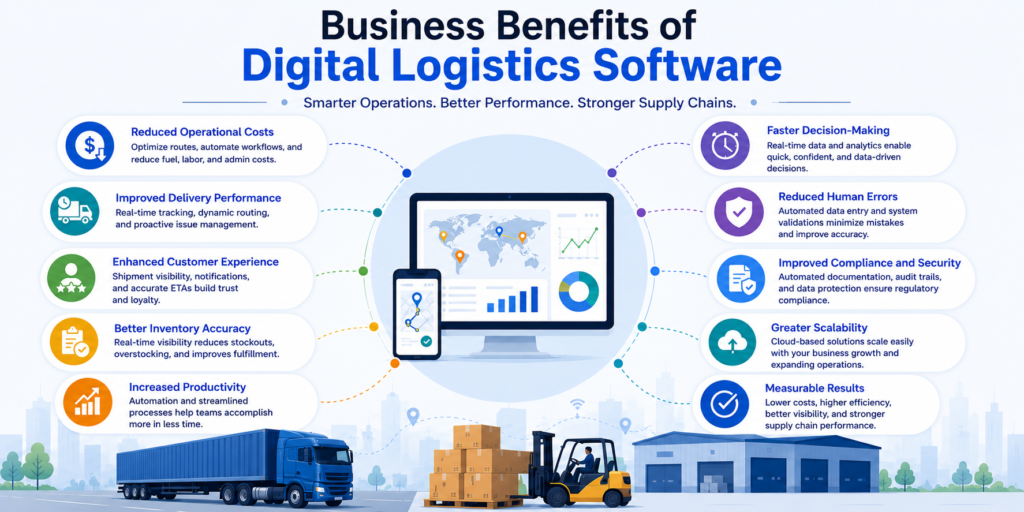
Implementing Digital Logistics Software delivers measurable improvements across transportation, warehousing, inventory management, and customer service operations. Beyond operational efficiency, these solutions help organizations increase profitability, improve decision-making, and build more resilient supply chains.
Reduced Operational Costs
One of the most immediate benefits is Reduced Operational Costs. Route optimization, automated workflows, and better resource utilization help lower fuel expenses, labor costs, and administrative overhead. Many businesses achieve ROI within the first few years through improved efficiency and reduced waste.
Improved Delivery Performance
Digital logistics platforms support Improved Delivery Performance by providing real-time tracking, dynamic route planning, and proactive issue management. These capabilities help increase on-time deliveries while reducing delays and transportation disruptions.
Enhanced Customer Experience
Modern customers expect visibility and transparency. Enhanced Customer Experience is achieved through shipment tracking, delivery notifications, accurate delivery estimates, and faster issue resolution. Improved communication strengthens customer trust and loyalty.
Better Inventory Accuracy
Accurate inventory data is critical for supply chain performance. Better Inventory Accuracy helps organizations reduce stockouts, prevent overstocking, and improve order fulfillment. Real-time inventory visibility also supports more effective planning and forecasting.
Increased Productivity
Automation and streamlined workflows contribute to Increased Productivity across logistics operations. Employees spend less time on repetitive administrative tasks and more time focusing on strategic activities that improve business performance.
Faster Decision-Making
Access to real-time data enables Faster Decision-Making. Managers can quickly identify operational issues, evaluate performance, and respond to changing conditions without waiting for manual reports or delayed updates.
Reduced Human Errors
Manual processes often lead to costly mistakes. Reduced Human Errors result from automated data entry, workflow automation, and system-driven validation processes that improve accuracy across logistics operations.
Improved Compliance and Security
Logistics organizations must comply with transportation, customs, and industry regulations. Improved Compliance and Security features help automate documentation, maintain audit trails, and protect sensitive operational data from unauthorized access.
Greater Scalability
As businesses expand, Greater Scalability becomes increasingly important. Cloud-based logistics solutions support higher shipment volumes, additional warehouses, and expanding transportation networks without requiring major infrastructure investments.
From a practical perspective, organizations often experience measurable outcomes such as lower transportation costs, improved delivery accuracy, higher warehouse productivity, and better customer retention. Real-world implementation benefits frequently include faster order fulfillment, increased operational visibility, and stronger overall supply chain performance, making Digital Logistics Software a valuable long-term investment.
Major Challenges in Logistics Digital Transformation
While the benefits of digital transformation are significant, organizations often face several obstacles during implementation. Successfully addressing these challenges is essential for maximizing the value of digital logistics initiatives.
Legacy Systems and Infrastructure
Many logistics businesses still depend on Legacy Systems and Infrastructure that were not designed for modern digital operations. These outdated systems often limit visibility and integration capabilities.
Solution: Adopt a phased modernization approach that gradually replaces aging technologies while minimizing operational disruption.
Expert Recommendation: Prioritize modernization efforts in areas that directly impact efficiency and customer service.
Data Silos
Data Silos occur when information is stored in separate systems across departments, making it difficult to gain a complete view of operations.
Solution: Implement centralized platforms that consolidate logistics data into a single source of truth.
Expert Recommendation: Establish data governance policies to improve consistency and accessibility across the organization.
Integration Complexity
Modern logistics ecosystems involve multiple technologies, suppliers, and service providers. Integration Complexity can create communication gaps between systems and reduce operational efficiency.
Solution: Use API-based platforms and integration tools that support seamless data exchange.
Expert Recommendation: Develop a clear integration strategy before implementing new software solutions.
Employee Resistance to Change
Digital transformation often encounters Employee Resistance to Change as teams adapt to new technologies and workflows.
Solution: Provide comprehensive training, clear communication, and ongoing support throughout the implementation process.
Expert Recommendation: Involve employees early in transformation initiatives to increase engagement and adoption.
Cybersecurity Concerns
As logistics systems become more connected, Cybersecurity Concerns continue to grow. Sensitive operational and customer data must be protected from cyber threats.
Solution: Implement strong security controls, including encryption, access management, monitoring tools, and employee awareness programs.
Expert Recommendation: Conduct regular security assessments to identify and address vulnerabilities.
Budget Constraints
Many organizations face Budget Constraints when investing in digital transformation projects. Initial implementation costs can appear significant, particularly for large-scale initiatives.
Solution: Focus on projects with clear ROI potential and measurable business benefits.
Expert Recommendation: Develop a business case that highlights long-term cost savings and operational improvements.
Regulatory Compliance Challenges
The logistics sector operates within a complex regulatory environment. Regulatory Compliance Challenges can complicate software implementation and process changes.
Solution: Select platforms with built-in compliance management and reporting capabilities.
Expert Recommendation: Involve compliance and legal teams throughout the implementation process to ensure regulatory requirements are addressed.
Lack of Digital Skills
A shortage of qualified professionals remains a major barrier to transformation. Lack of Digital Skills can slow implementation and reduce the effectiveness of new technologies.
Solution: Invest in workforce training, certification programs, and partnerships with experienced technology providers.
Expert Recommendation: Build a long-term digital talent strategy that combines internal skill development with external expertise.
Although these challenges can be significant, organizations that approach Logistics Digital Transformation with clear objectives, strong leadership, and structured implementation plans are far more likely to achieve successful outcomes and sustainable business value.
Real-World Examples of Digital Logistics Transformation
Across the logistics industry, organizations are using digital technologies to improve efficiency, strengthen supply chain visibility, and enhance customer service. While transformation strategies vary by company, successful implementations demonstrate how technology can deliver measurable business results.
How Global Logistics Leaders Use Technology
Many leading logistics organizations have invested heavily in real-time shipment visibility solutions. By combining GPS tracking, cloud platforms, and IoT-enabled monitoring systems, they can track shipments throughout the supply chain and respond quickly to delays or disruptions. This visibility improves planning, customer communication, and overall operational control.
Another area of focus is warehouse automation. Businesses are implementing automated storage systems, barcode scanning, robotics, and intelligent inventory management tools to increase productivity and improve order accuracy. These technologies help warehouses process higher volumes while reducing manual effort.
Organizations are also leveraging AI-powered forecasting to improve demand planning and inventory management. By analyzing historical sales patterns, seasonal trends, and market conditions, AI systems help businesses maintain optimal inventory levels and reduce supply chain inefficiencies.
In transportation operations, fleet optimization technologies are helping companies reduce fuel consumption, improve vehicle utilization, and lower maintenance costs. Route optimization software, telematics systems, and predictive maintenance tools enable logistics providers to operate more efficiently while improving delivery performance.
Lessons Learned from Successful Implementations
Several important lessons have emerged from successful digital transformation projects. One of the most common success factors is strong executive support. Organizations that align technology initiatives with business goals are typically more successful than those pursuing technology for its own sake.
Among the most effective best practices is adopting a phased implementation strategy. Rather than attempting a complete transformation at once, successful companies often focus on high-priority areas first and expand gradually as they achieve measurable results.
Employee training is another critical factor. Organizations that invest in change management and user adoption programs generally experience faster implementation success and higher technology utilization rates.
There are also several avoidable mistakes businesses should recognize. Poor integration planning can create data silos and limit visibility across operations. Similarly, unclear objectives often make it difficult to measure success or justify future investments.
The most successful organizations combine technology adoption with process improvement, employee engagement, and long-term strategic planning to maximize the value of digital logistics transformation. To achieve these outcomes, many businesses leverage Logistics Software Development Services in Dubai to build scalable, integrated, and future-ready logistics solutions tailored to their operational needs.
How to Choose the Right Digital Logistics Software
Selecting the right Digital Logistics Software requires careful evaluation of current needs and future business goals. The ideal solution should not only address today’s operational challenges but also support long-term growth and digital transformation initiatives.
Define Business Objectives
The first step is to Define Business Objectives. Organizations should identify whether their primary goals involve reducing transportation costs, improving delivery performance, increasing visibility, automating workflows, or enhancing customer experiences. Clear objectives help narrow software options and establish implementation priorities.
Assess Current Logistics Processes
Businesses should also Assess Current Logistics Processes to identify inefficiencies, bottlenecks, and operational gaps. Understanding existing workflows helps determine which features and capabilities will deliver the greatest business value.
Evaluate Scalability Requirements
Future growth should always be considered when selecting logistics technology. Companies must Evaluate Scalability Requirements to ensure the platform can support additional warehouses, transportation assets, users, and shipment volumes without requiring major system changes.
Review Integration Capabilities
Since logistics operations often involve multiple software platforms, businesses should carefully Review Integration Capabilities. Seamless integration with ERP systems, CRM platforms, warehouse software, eCommerce solutions, and third-party providers is essential for maintaining visibility and operational efficiency.
Prioritize Security Features
Organizations should Prioritize Security Features such as encryption, access controls, authentication mechanisms, and compliance support. Strong cybersecurity protections help safeguard sensitive operational and customer data.
Consider Vendor Expertise
It is equally important to Consider Vendor Expertise. Businesses should evaluate a vendor’s industry experience, implementation methodology, technical support capabilities, and long-term product roadmap before making a decision.
For organizations seeking tailored solutions, partnering with a Logistics Software Development Company in Dubai can provide industry-specific expertise and customized functionality aligned with business requirements.
Calculate Total Cost of Ownership
Finally, businesses should Calculate Total Cost of Ownership rather than focusing only on initial pricing. This includes implementation costs, licensing fees, customization expenses, training requirements, maintenance, and ongoing support.
By evaluating these factors carefully, organizations can select a logistics solution that delivers strong operational value, supports future growth, and generates a sustainable return on investment.

Custom Logistics Software vs Off-the-Shelf Solutions
When adopting Digital Logistics Software, businesses must decide whether to invest in a custom-built solution or implement a ready-made platform. Both options offer distinct advantages, and the right choice depends on operational complexity, budget, and long-term business goals.
Advantages of Custom Logistics Software
Custom Logistics Software is designed around specific business requirements. It allows organizations to build workflows, integrations, reporting tools, and automation capabilities that align directly with their operations. This flexibility helps companies address unique logistics challenges while maintaining full control over future enhancements and feature development.
Benefits of Ready-Made Platforms
Ready-Made Platforms provide faster deployment and lower initial implementation costs. These solutions typically include standard logistics features such as shipment tracking, inventory management, transportation planning, and reporting. They are often ideal for businesses seeking rapid digital transformation without extensive development timelines.
Cost Comparison
In terms of Cost Comparison, ready-made solutions generally require lower upfront investment because they use subscription-based pricing models. Custom software typically involves higher development costs initially but can reduce long-term dependency on licensing fees and vendor limitations.
Scalability Comparison
When evaluating Scalability Comparison, custom solutions often provide greater flexibility as business requirements evolve. Organizations can add new features, integrations, and operational capabilities without being constrained by predefined software limitations. Ready-made platforms may scale effectively for many businesses but can become restrictive as operations grow more complex.
Security Comparison
For Security Comparison, both options can offer strong protection. However, custom solutions provide greater control over data management, security policies, and compliance requirements. Ready-made platforms benefit from vendor-managed updates and dedicated security resources but rely heavily on third-party infrastructure.
Which Option Is Best for Growing Businesses?
The answer depends on growth objectives and operational needs. Businesses with relatively standard processes may benefit from ready-made solutions due to faster deployment and lower initial costs. However, organizations expecting significant growth, specialized workflows, or unique integration requirements often gain greater long-term value from custom platforms.
Many expanding companies choose providers offering Logistics Software Development Services in Dubai to build tailored solutions that support future scalability, operational efficiency, and competitive differentiation.
Why Businesses Are Investing in Logistics Software Development
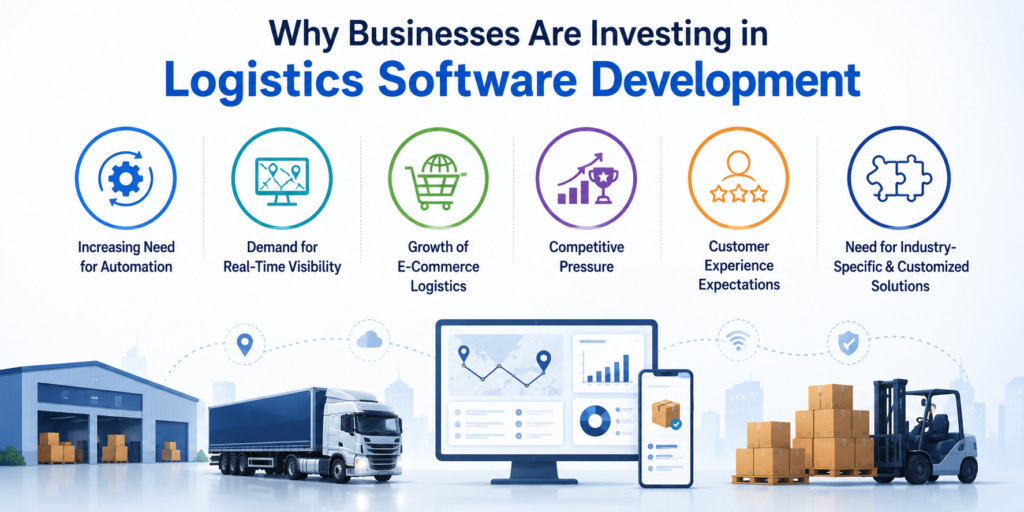
Investment in Logistics Software Development continues to rise as organizations seek greater efficiency, visibility, and agility in increasingly complex supply chain environments. Digital technologies are no longer viewed as optional improvements but as essential business capabilities.
Increasing Need for Automation
One of the primary drivers is the Increasing Need for Automation. Businesses are automating order processing, inventory management, reporting, shipment scheduling, and customer communication to reduce manual effort and improve operational efficiency.
Demand for Real-Time Visibility
The growing Demand for Real-Time Visibility is another major factor. Companies need immediate access to shipment status, inventory levels, transportation performance, and operational metrics to make informed decisions and respond quickly to disruptions.
Growth of E-Commerce Logistics
The rapid Growth of E-Commerce Logistics has increased pressure on fulfillment and delivery operations. Consumers expect faster shipping, accurate tracking, and seamless delivery experiences, requiring more advanced logistics technology.
Competitive Pressure
Organizations also face significant Competitive Pressure. Businesses that leverage modern logistics solutions can reduce costs, improve service quality, and respond more effectively to market changes, creating a strong competitive advantage.
Customer Experience Expectations
Rising Customer Experience Expectations continue to drive digital investment. Customers expect transparency, reliability, and real-time communication throughout the delivery process. Meeting these expectations requires sophisticated logistics platforms capable of supporting end-to-end visibility and operational excellence.
Many organizations seek specialized Logistics Software Development partners because off-the-shelf solutions may not fully support their operational requirements. Different industries often require unique workflows, compliance features, integration capabilities, and reporting structures. These industry-specific customization requirements make tailored software solutions an increasingly attractive option for businesses pursuing long-term digital transformation.
Future Opportunities and Innovation in Logistics
The future of logistics will be shaped by intelligent technologies, connected ecosystems, and advanced automation capabilities. As digital transformation continues to evolve, businesses will gain access to new opportunities that improve efficiency, resilience, and customer satisfaction.
AI-Driven Supply Chains
AI-Driven Supply Chains will increasingly automate planning, forecasting, inventory optimization, and transportation management. Artificial intelligence will help organizations anticipate demand changes, identify disruptions, and make proactive operational decisions.
Autonomous Logistics Networks
The emergence of Autonomous Logistics Networks will transform transportation and warehousing operations. Self-driving vehicles, delivery robots, and automated warehouse systems have the potential to improve efficiency, reduce labor dependency, and enhance operational consistency.
Digital Supply Chain Ecosystems
Future logistics operations will rely heavily on Digital Supply Chain Ecosystems that connect suppliers, carriers, warehouses, distributors, and customers through integrated digital platforms. These ecosystems will improve collaboration, transparency, and decision-making across the supply chain.
Sustainable Logistics Technologies
Growing environmental concerns are accelerating investment in Sustainable Logistics Technologies. Route optimization, electric vehicles, energy-efficient warehouses, and carbon monitoring systems will help organizations reduce emissions while improving operational performance.
Generative AI in Logistics Operations
The rise of Generative AI in Logistics Operations is creating new opportunities for automation and decision support. Generative AI can assist with planning, reporting, customer communication, operational analysis, and workflow optimization, helping teams work more efficiently.
Predictive Risk Management
Supply chain resilience will increasingly depend on Predictive Risk Management. Advanced analytics and AI-powered monitoring systems will identify potential disruptions before they occur, allowing organizations to respond proactively and minimize operational impact.
Logistics-as-a-Service (LaaS)
The growth of Logistics-as-a-Service (LaaS) will provide businesses with flexible access to logistics capabilities through cloud-based service models. Organizations can leverage advanced technology, transportation management, and fulfillment services without significant infrastructure investments.
Smart Global Trade Networks
The future of international commerce will be supported by Smart Global Trade Networks that integrate customs management, trade documentation, shipment visibility, and regulatory compliance into unified digital environments. These networks will simplify cross-border operations and improve supply chain efficiency.
As these innovations continue to mature, businesses are increasingly partnering with providers specializing in Custom Logistics Software Development in Dubai to build future-ready platforms that support automation, scalability, and long-term competitive growth.
Expert Recommendations for Logistics Leaders in 2026
As logistics operations become increasingly digital, leaders must adopt strategies that maximize the value of technology investments while ensuring long-term operational success. The following recommendations can help organizations navigate digital transformation more effectively in 2026 and beyond.
Focus on Data Quality
The success of modern logistics technologies depends heavily on accurate and reliable information. Leaders should Focus on Data Quality by establishing clear data governance standards, eliminating duplicate records, and ensuring consistency across systems. High-quality data improves forecasting, reporting, automation, and decision-making.
Invest in Scalable Platforms
Businesses should Invest in Scalable Platforms that can support future growth and changing operational requirements. Cloud-based and modular solutions provide the flexibility needed to accommodate additional warehouses, transportation assets, customers, and shipment volumes without major infrastructure changes.
Prioritize User Adoption
Technology implementation is only successful when employees actively use the system. Organizations must Prioritize User Adoption through training programs, change management initiatives, and ongoing support. When employees understand the benefits of digital tools, adoption rates and overall project success improve significantly.
Build an Automation Roadmap
Rather than automating processes randomly, businesses should Build an Automation Roadmap aligned with strategic objectives. Identifying high-impact opportunities first allows organizations to generate measurable results while creating a foundation for broader automation initiatives.
Measure ROI Continuously
Digital transformation should be evaluated as an ongoing business investment. Leaders should Measure ROI Continuously by tracking key performance indicators such as transportation costs, delivery accuracy, inventory turnover, customer satisfaction,
Why Choose SISGAIN for Logistics Software Development?
SISGAIN helps logistics businesses build scalable, secure, and future-ready software solutions that streamline operations and improve supply chain performance. With expertise in AI, automation, fleet management, warehouse systems, and transportation platforms, our team delivers custom solutions designed to solve real-world logistics challenges.
Whether you need a transportation management system, warehouse management platform, or end-to-end logistics ecosystem, SISGAIN combines industry expertise with cutting-edge technology to help your business stay competitive in the digital era.
Conclusion
The logistics industry is rapidly evolving as businesses face increasing supply chain complexity, rising customer expectations, and continuous technological advancements. In this environment, Digital Logistics Software has become essential for improving visibility, streamlining operations, reducing costs, and building more resilient supply chains.
As discussed throughout this guide, technologies such as AI, IoT, cloud computing, blockchain, and predictive analytics are transforming logistics operations, while trends like hyperautomation, smart warehouses, and end-to-end supply chain visibility are shaping the future of the industry. Although challenges such as legacy systems, integration issues, cybersecurity risks, and skill gaps remain, organizations that invest in the right technology and implementation strategy can overcome these obstacles successfully.
Looking ahead, innovations such as AI-driven supply chains, autonomous logistics networks, Generative AI, and Logistics-as-a-Service (LaaS) will continue to create new opportunities for efficiency and growth. By focusing on scalable solutions, data quality, automation, and user adoption, logistics businesses can maximize the value of their digital transformation initiatives.
Organizations that embrace digital transformation in logistics today will be better positioned to improve efficiency, reduce costs, enhance customer experiences, and remain competitive in an increasingly connected global supply chain ecosystem.
Frequently Asked Questions
What is Digital Logistics Software?
Digital Logistics Software is a platform that helps businesses manage transportation, warehousing, inventory, shipments, and supply chain operations through automation and real-time data visibility.
How does digital transformation improve logistics operations?
Digital transformation improves logistics by automating processes, increasing supply chain visibility, reducing operational costs, improving decision-making, and enhancing delivery performance.
What are the key features of modern logistics software?
Key features include transportation management, warehouse management, inventory tracking, fleet monitoring, route optimization, shipment visibility, analytics, and automated reporting.
What challenges do companies face during logistics digital transformation?
Common challenges include legacy systems, data silos, integration complexity, cybersecurity risks, budget constraints, employee resistance, and lack of digital skills.
