
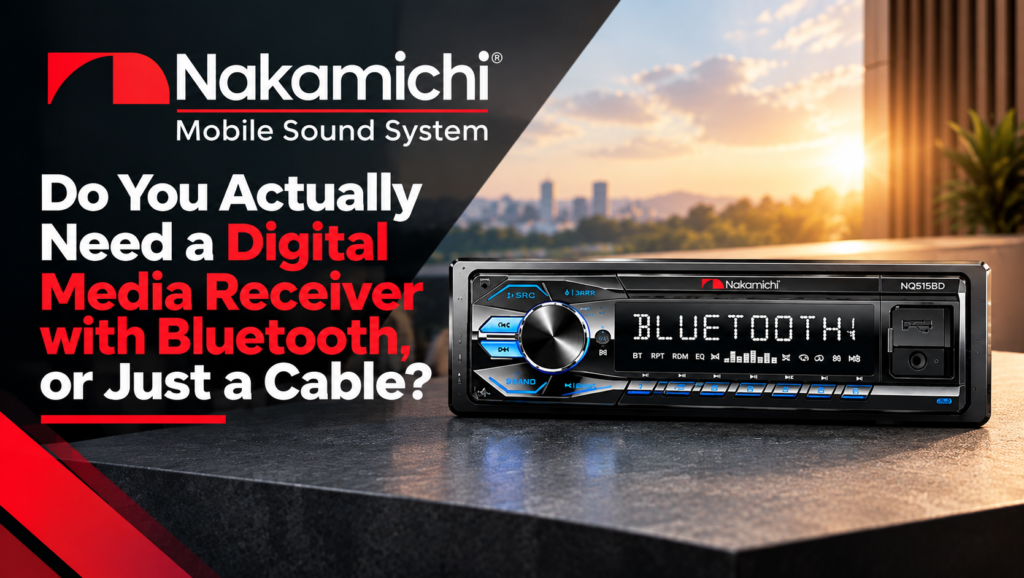
Why does a car stereo need Bluetooth build in when every phone already has it? Fair question, and the honest answer is most people don’t strictly need it. They just get tired of untangling a cable every time they get in the car, plugging it in wrong on the first try, then giving up and driving in silence for the fifth time that month.
What a digital media receiver actually replaces
Old head units played whatever was in the CD slot or the tape deck, nothing else. Digital media receivers do everything a phone can already do, minus the screen, and route it through actual car speakers instead of a tinny phone speaker fighting road noise for attention.
Swapping in a car digital media receiver usually means losing the CD slot entirely, which surprises people who assumed the new unit would just add features on top of the old ones. Most modern units skip physical media altogether. Storage lives on a phone or a USB stick plugged into the dash, not in a spinning disc anymore.
Video playback works too on most current units, though it locks out automatically once the car’s moving — a safety feature nobody complains about until they’re stuck at a long red light wanting to watch something for thirty seconds.
Bluetooth built in vs a cheap aux adapter
A digital media receiver with Bluetooth costs more upfront than a basic wired unit plus a five-hundred-rupee aux adapter. Not by a huge margin these days, but enough that some buyers try to save money there first.
Here’s the thing — cheap Bluetooth adapters drop connection constantly, especially once the phone’s more than a couple of meters from the receiver. Built-in Bluetooth on a proper media receiver for car use holds a stable connection because the antenna and chipset are actually matched to the unit, not bolted on as an afterthought. Nakamichi’s Bluetooth-equipped receivers run on a chipset rated for close to 10 meters of range in open air, well past the 5 or 6 meters most bundled adapters manage before the connection starts cutting out.
Multi-device pairing is where cheaper units usually cut corners first. A single-pairing digital media receiver forces you to manually reconnect every time a second phone tries to join, which gets old fast in a family car where two or three people alternate playing music on a long drive.
Picking one that won’t annoy you in six months
Screen brightness in direct sunlight is the detail nobody checks before buying. Cheap displays wash out completely at noon, forcing drivers to squint at a barely visible track name while trying to keep their eyes on the road.
Button response matters just as much as screen quality. A laggy touchscreen on any digital media receiver sold at the budget end of the market makes basic tasks like skipping a track feel like fighting the unit instead of using it.
Wiring harness compatibility trips up more installs than people expect. Cars built after roughly 2018 often use a different connector standard than what ships in the box, meaning an installer needs a separate harness adapter before anything even powers on. Skipping that step is the single most common reason a fresh install doesn’t turn on the first time.
None of this needs to be complicated. Figure out whether Bluetooth actually solves a daily annoyance or just looks good on a spec sheet, check harness compatibility before buying, and the rest mostly sorts itself out during a normal install.
FAQs
Is a digital media receiver with Bluetooth worth the extra cost over a wired setup?
For most daily drivers, yes — the convenience adds up fast once you stop fumbling with a cable every trip.
Does a car digital media receiver replace the need for a separate amplifier?
No. Most receivers have a built-in amp for basic use, but a dedicated external amp still outperforms it for real volume or sound quality.
Can I install a media receiver for car use myself?
Mostly yes, if the car already has a standard DIN slot. Older or luxury models sometimes need an adapter harness, which complicates things a bit.
Why does Bluetooth range vary so much between receivers?
Chipset quality and antenna placement. Budget units cut corners here first since it’s invisible to most buyers at the counter.
Do digital media receivers work without a smartphone connected at all?
Yes, most still play from a USB drive or SD card directly, no phone required.