

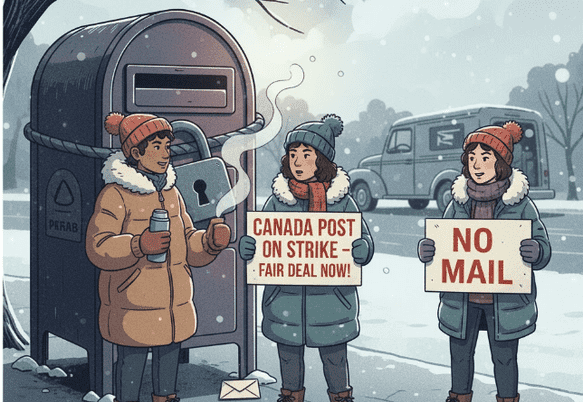
Once the present century’s most prominent labor disagreement in Canada, the Canada Post labor strike has touched on day-to-day life, business, and the national economy to emphasize the vast contention between service disruption and worker rights reform. This blog will explore causes, progress to the postal strike, its consequences, and essential insights for Canadians and their businesses on this historic occasion of labor disputes.
What does the Canada Post strike refer to?
The Canada Post strike refers to the current labor activities between the Canadian Union of Postal Workers and Canada Post, a government-owned postal service responsible for sending mail and parcels throughout the nation. These disputes have fallen into strikes, on-and-off strikes, and other job actions, which have wreaked havoc with the mail delivery in Canada.
A GALAM Strike History
These labor disputes stemmed from contract negotiations over wages, benefits, working conditions, and restructuring proposals aimed at modernizing Canada Post’s operations. The union contended that postal workers deserve fair compensation and protection, quoting the company’s need for financial sustainability and operational changes.
Timeline of the Strike
The most important strike activity started at the beginning of the fall in 2025 when CUPW members declared a nationwide strike due to the stalling of talks with Canada Post. This became a blow to postal services and affected millions of Canadians.
There was a stage when the union changed the strike from a full-scale strike to a rolling strike, units and regions stopping work in an actual scheduled manner. This was to keep pressure on proximity bargaining, but some postal services would continue.
At the end of December 2025, Canada Post and CUPW tentatively reached an agreement, suspending all strike activity until the deal could be voted on by union members.
What Services Are Affected?
At the worsening peak of the Canada Post Strike, every corner of the country bore the burden of such strikes on postal services:
Mail delivery: Air: Custom mail and packages of various forms were delayed or not delivered at all.
Post office operations: Many offices shut or limped by on a skeletal service plan.
Shipping and return: Many of the businesses using Canada Post services were faced with delays in shipping and business returns, respectively.
International mail: Cross-border orders were significantly affected all throughout the globe, and also slowed down global trade and logistics.
While some union strikes saw to the delivery of government cheques like the Canada Pension Plan (CPP) and Canada Child Benefit (CCB) payments, all other mail services came to a halt.
How the Strike Hits Canadian Businesses
The Canada Post Strike has had severe economic consequences, especially for small and medium-sized businesses.
Various small businesses have complained of lost revenue, higher expenses as a result of alternative transport modes, and upset customers. A recent survey showed that some 75% of small business owners suffer from these negative consequences, including significant financial loss.
The growth of e-commerce across Canada will lead to canceled and delayed orders during seasonal rushes such as Black Friday and Christmas.
With Rural and remote businesses getting this blow hardest, Canada Post is often their only cheap delivery option.
Several companies began investigations (due to repeated disruptions) into privatized carriers, such as FedEx, UPS, and private door-to-door delivery alternatives, potentially changing the landscape and landscape of the Canadian shipping industry over the long term.
Impact on Canadians & Daily Life
The Canada Post strike is a source of inconvenience and disbelief for typical Canadians.
Delayed Bills and Correspondence: Without regular mail services, payments and correspondence were delayed, disrupting personal financial planning.
Package Backlogs: When the services resumed, millions of parcels were queued for distribution.
Passport Delays: Government documents such as passports had longer waits because ordinary mail services were affected.
Holiday Delays: The strike around the busiest shopping time made gift and online order collection harder for families.
Why the Strike Happened: Union vs. Reform
The sorting out of the strike was not just about wages and benefits, but also about the larger formal changes the Canadian Royal Post has introduced, along with the federal government, for modernizing postal services, such as ending door-to-door delivery service to most households. Instead, the behemoth would prefer mailbox clusters in communities-a move to which labor seems to be opposed.
CUPW contends this undercuts jobs and service quality, especially in rural areas, while it is about adjusting to the collapse of postal items to contend with the massive competition for parcels, according to Canada Post.
The Way Forth: talks and fixing. On May 9, 2026, the strike in the service was suspended pending possible agreement; the agreement, of course, turned out to be slightly different from what the members.
Even with that, the Canada Post Strike agreement is within the framework of a fabric of balancing the interests of unions and management, in the architecture of strategies to make it more competitive in the long-term interests of Canada’s postal services.
What The Canada Post Strike Means
The strike is not just an industrial problem but represents several concerns in Canadian affairs. Among other things, the points of contention raised among the public are as follows:
- Trying to balance equitable labor practices with its finances.
- The significance of postal services in everyday life and commerce.
- How labor disputes can reshape industries and consumer behavior.
The recent strike, for Canadians and businesses alike, highlights the importance of dependable postal services and underscores the need for a lasting solution to ensure the country’s economic and social welfare.
Whether you’ve missed packages, been late on your bills, or had no choice but to reschedule your store operations, the Canada Post Strike has made a permanent mark in the Canadian postal landscape.
