
Modern businesses rely on technology for almost everything, from customer communication and employee collaboration to data management and daily operations. But as technology becomes more important, managing it also becomes more complicated. Multiple applications, cloud platforms, connected devices, security requirements, and software systems can quickly create operational challenges.
This is where it service management consultancy can make a meaningful difference. Instead of treating IT as a collection of separate tools, consultancy helps businesses look at technology as a complete operational environment. The goal is not simply to fix technical problems. It is to improve how technology supports employees, customers, processes, security, and long-term business goals.
For working professionals, startups, and software development researchers in the USA, this approach is becoming increasingly relevant. A well-planned IT environment can reduce unnecessary friction, improve service quality, and create a stronger foundation for future technology investments.
What Exactly Does IT Service Management Consultancy Include?
It service management consultancy refers to professional guidance that helps organizations plan, improve, manage, and optimize their IT service processes. It connects technology operations with business requirements so that IT services are reliable, measurable, secure, and useful.
IT service management, commonly called ITSM, covers processes such as incident management, service requests, problem management, change management, asset management, and service monitoring. These processes determine how technology-related issues are reported, handled, documented, and improved.
A consultancy can examine an organization’s existing IT environment and identify gaps. It may then recommend better workflows, tools, governance models, automation opportunities, or service management practices.
In simple terms, the focus moves from “How do we fix this issue?” to “How can we prevent this type of issue from repeatedly affecting the business?” That shift can have a surprisingly large impact.
Why Can ITSM Be Valuable for Startups?
Startups often move quickly. New applications are launched, employees are added, cloud platforms are adopted, and processes change almost overnight. That flexibility is useful, but unmanaged growth can create technical debt, inconsistent support, and unnecessary downtime.
An IT service management consultancy can help startups establish practical processes before those problems become expensive. Instead of building a large and complicated IT department immediately, a startup can introduce clear workflows for support, access management, incident handling, security, and technology changes.
The biggest benefit is predictability. Employees know where to report issues, technical teams know how to prioritize requests, and leadership can see which technology problems are affecting productivity.
What Can Startups Gain From Structured IT Management?
- Faster response to technical issues
- Better visibility into IT operations
- More consistent employee support
- Easier technology scaling
- Reduced operational confusion
- Better documentation and knowledge sharing
- More informed technology decisions
A startup does not need hundreds of IT employees to benefit from structured service management. It needs sensible processes that can grow with the business.
How Can Connected Devices Change IT Service Management?
Connected devices are becoming common across manufacturing, healthcare, logistics, retail, energy, and office environments. Sensors, smart equipment, wearable devices, connected vehicles, and other technologies continuously generate operational data.
An internet of things app development company can help businesses create software that connects these devices with applications, dashboards, databases, and business systems. The connection becomes particularly useful when IT teams need real-time information about equipment, environments, or operations.
For example, connected sensors can report temperature, equipment status, energy consumption, or unusual activity. Instead of waiting for a manual inspection, a business can receive information automatically and respond sooner.
How Does IoT Support Better IT Operations?
IoT can support IT and operational teams through:
- Real-time monitoring: Teams can observe connected assets and environments continuously.
- Automated alerts: Systems can notify the right people when predefined conditions occur.
- Predictive maintenance: Data patterns can help identify possible equipment problems before failure.
- Remote visibility: Teams can monitor assets without being physically present.
- Data-driven decisions: Operational information can be used to improve planning and resource allocation.
The real value of IoT is not simply connecting devices. It is turning device-generated data into information that people can actually use.
Can Blockchain Improve Enterprise Technology Processes?
Blockchain is often associated with cryptocurrency, but its underlying technology has broader applications. A blockchain is a distributed digital record where transactions or data entries can be recorded and verified across a network according to defined rules.
For businesses, custom blockchain development can be useful when multiple parties need greater transparency, traceability, or shared access to trusted records. Possible applications include supply-chain tracking, digital identity, document verification, asset management, and transaction workflows.
However, blockchain is not a magic solution for every database problem. Businesses should first identify whether decentralization, shared verification, immutability, or smart-contract automation actually solves a specific operational challenge.
When the business case is clear, custom blockchain development can become part of a broader technology strategy rather than an isolated experiment.
What Role Does a Digital Workplace Play in Modern IT?
A digital workplace refers to the collection of technologies employees use to communicate, collaborate, access information, and complete their work. It can include collaboration platforms, cloud applications, employee portals, productivity tools, communication systems, and secure remote-access solutions.
A consultant digital workplace can help organizations evaluate how these technologies work together. The focus is not simply on purchasing more software. It is about making the employee experience more connected and efficient.
Consider a company where employees use separate systems for messaging, document management, project tracking, HR requests, and IT support. If those systems do not communicate properly, employees may spend more time searching for information than actually using it.
A well-planned digital workplace can help address this problem through:
- Centralized access to business information
- Better collaboration between teams
- Improved remote-work support
- Simplified employee workflows
- Stronger access controls
- Better integration between business applications
For working professionals, these improvements can have a direct effect on productivity. Fewer unnecessary steps usually mean more time for meaningful work.
Can AR and VR Support IT and Employee Training?
Augmented Reality (AR) adds digital information to the physical environment, while Virtual Reality (VR) creates an immersive digital environment. Both technologies can be used beyond entertainment, particularly for training, simulation, visualization, maintenance, and remote assistance.
ar vr app development services can help businesses create applications designed around specific operational requirements. For example, a manufacturing company might use immersive training to teach employees how to operate equipment without exposing beginners to real-world risks.
AR can also support technicians by displaying instructions, diagrams, or equipment information while they work. VR, on the other hand, can create controlled environments where employees practice complex procedures.
Which Business Areas Can Benefit?
- Employee training and onboarding
- Equipment maintenance
- Safety simulations
- Product demonstrations
- Remote assistance
- Technical education
- Design and visualization
The important point is to start with the business problem rather than the technology. A flashy VR application may look impressive, but it should also solve a real operational need.
How Should Businesses Connect These Technologies?
Technology works best when systems support one another instead of operating as isolated islands. ITSM can provide the operational structure, while IoT, blockchain, digital workplace tools, and immersive technologies can address specific business requirements.
For example, an internet of things app development company may create a connected monitoring application, while IT service processes determine how alerts are handled. Similarly, blockchain may provide trusted transaction records while internal IT systems manage user access and application support.
The technologies are different, but the objective is similar: helping businesses operate with greater visibility, control, and efficiency.
What Should Businesses Look for Before Choosing a Consultancy?
Choosing a technology partner should involve more than comparing service lists. Businesses should look at expertise, communication, scalability, security practices, integration capabilities, and the partner’s understanding of their industry.
A reliable IT service management consultancy should begin by understanding the organization’s current environment. That includes existing applications, support processes, infrastructure, employee needs, service challenges, and long-term goals.
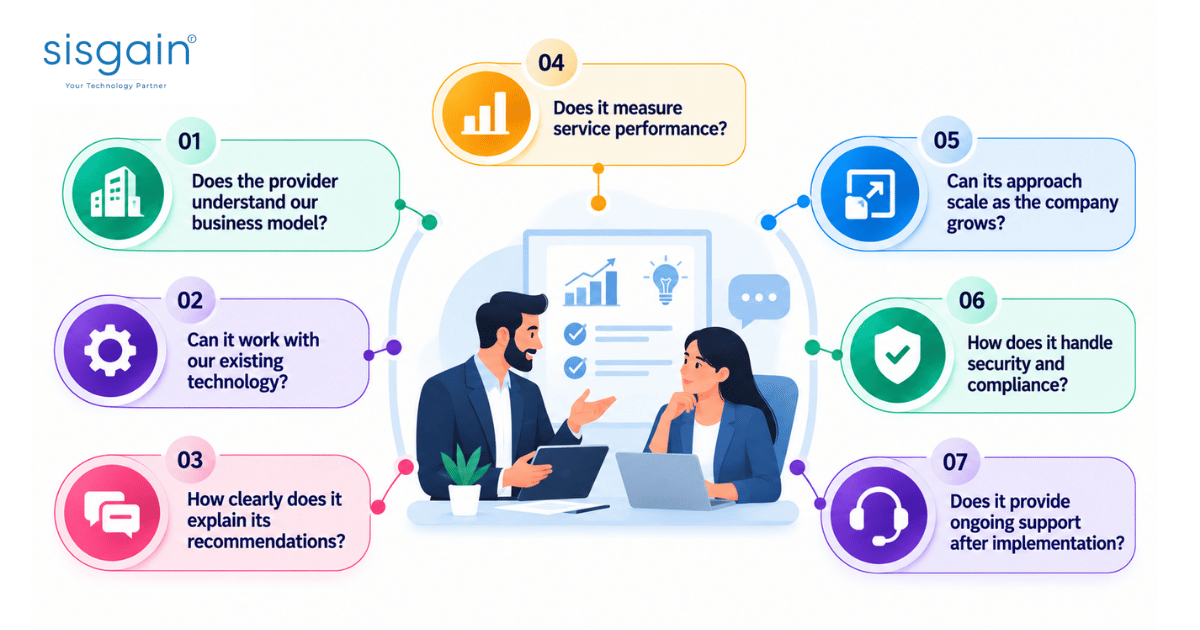
Before making a decision, businesses should consider these questions:
- Does the provider understand our business model?
- Can it work with our existing technology?
- How clearly does it explain its recommendations?
- Does it measure service performance?
- Can its approach scale as the company grows?
- How does it handle security and compliance?
- Does it provide ongoing support after implementation?
The right provider should make technology easier to manage, not create another layer of confusion.
What Common IT Management Mistakes Should Businesses Avoid?
Many technology problems are not caused by a lack of software. They happen because processes are unclear or responsibilities are poorly defined.
Businesses should avoid implementing tools without first understanding the problem they are intended to solve. Buying an expensive platform will not automatically improve service quality if employees do not know how to use it or if workflows remain unclear.
Other common mistakes include:
- Ignoring employee feedback
- Tracking too many unnecessary metrics
- Treating every IT issue as equally urgent
- Failing to document important processes
- Neglecting cybersecurity during technology expansion
- Choosing tools without considering integration
- Focusing only on short-term cost
Technology decisions should support measurable business outcomes. Otherwise, organizations can end up with a very impressive collection of software that nobody particularly enjoys using.
What Important Points Should Businesses Remember?
Businesses should remember that effective technology management starts with business needs, not technology trends. ITSM should create clear processes, IoT should generate useful operational information, blockchain should solve specific trust or traceability problems, and digital workplace tools should make work easier.
AR and VR should have a practical purpose, especially when used for training or visualization. Most importantly, every technology investment should be evaluated through measurable outcomes such as productivity, reliability, user experience, security, scalability, and operational efficiency.
How Can Businesses Build a More Future-Ready Technology Strategy?
A future-ready technology strategy does not mean adopting every new technology that appears in the market. It means creating a flexible foundation that allows useful technologies to be adopted when they make business sense.
For example, a company may start by improving its service-management processes. Once those processes are stable, it can connect monitoring tools, automate repetitive support tasks, integrate business applications, and introduce advanced technologies where they provide measurable value.
A consultant digital workplace can help organizations improve employee-facing systems, while an internet of things app development company can support connected operations. Businesses may also explore ar vr app development services for training and visualization or blockchain solutions for specialized data and transaction requirements.
This approach reduces unnecessary technology spending while keeping the organization prepared for future changes.
What Could the Future of IT Service Management Look Like?
The future of IT service management will likely become more automated, data-driven, and closely connected to business operations.
Artificial intelligence can help classify support requests, identify patterns, summarize incidents, and assist service teams. Automation can handle repetitive requests. Predictive analytics can help organizations identify potential problems before they become major disruptions.
At the same time, businesses will need stronger governance as their technology environments become more complex.
The next generation of it service management consultancy will therefore involve more than traditional service desk improvement. It will increasingly connect IT operations with cloud infrastructure, cybersecurity, data, automation, connected devices, and employee experience.
For business leaders, that means IT can become less of a cost center focused on fixing problems and more of a structured capability that supports growth.
Why Could SISGAIN Technology Be Worth Exploring?
SISGAIN Technology helps businesses turn technology ideas into practical software solutions designed around real operational needs. Its work spans software development, connected technology solutions, immersive experiences, blockchain-based applications, cloud solutions, and enterprise-focused digital products.
The company focuses on combining technical expertise with business understanding, helping organizations improve processes, build useful applications, and prepare for changing technology requirements. For startups and established businesses alike, SISGAIN Technology can provide the development experience and technical support needed to move from an idea to a dependable digital solution.
Conclusion: Can Better IT Management Create Better Business Outcomes?
Yes, when technology is managed with a clear business purpose. Strong IT service management can improve reliability, organize support processes, reduce operational friction, and give leadership better visibility into technology performance.
The wider technology ecosystem also creates new opportunities. IoT can connect physical operations, blockchain can strengthen transparency, digital workplace solutions can improve employee productivity, and AR/VR can make training and visualization more practical.
The key is balance. Businesses should not adopt technology simply because it is popular. They should choose solutions that solve real problems, integrate with existing systems, protect valuable information, and create measurable value. With the right strategy and expert guidance, technology can move from being a support function to becoming a genuine driver of business growth.
FAQs
1. What are the benefits of iot application development services?
iot application development services help businesses connect devices, collect useful data, and automate daily processes. They can improve operational visibility, efficiency, and decision-making across different industries.
2. How can augmented and virtual reality software development help businesses?
Augmented and virtual reality software development can create interactive training, product visualization, remote assistance, and immersive customer experiences. These solutions can make complex processes easier to understand and use.
3. Why do businesses invest in custom blockchain development?
Custom blockchain development allows businesses to build secure solutions based on their specific operational needs. It can support better data transparency, automation, transaction tracking, and decentralized workflows.
4. What does a digital workplace company provide?
A digital workplace company helps organizations improve how employees communicate, collaborate, access information, and manage daily tasks. Its solutions can create a more connected and productive work environment.
5. When should a business consider it service management consultancy?
Businesses can consider it service management consultancy when IT operations become difficult to manage, scale, or align with business goals. Professional guidance can help improve processes, service quality, and technology planning.
6. What services does a blockchain development agency offer?
A blockchain development agency can provide blockchain strategy, application development, smart contract solutions, integration, and ongoing technical support. Services are usually tailored to the company’s specific use case and requirements.