
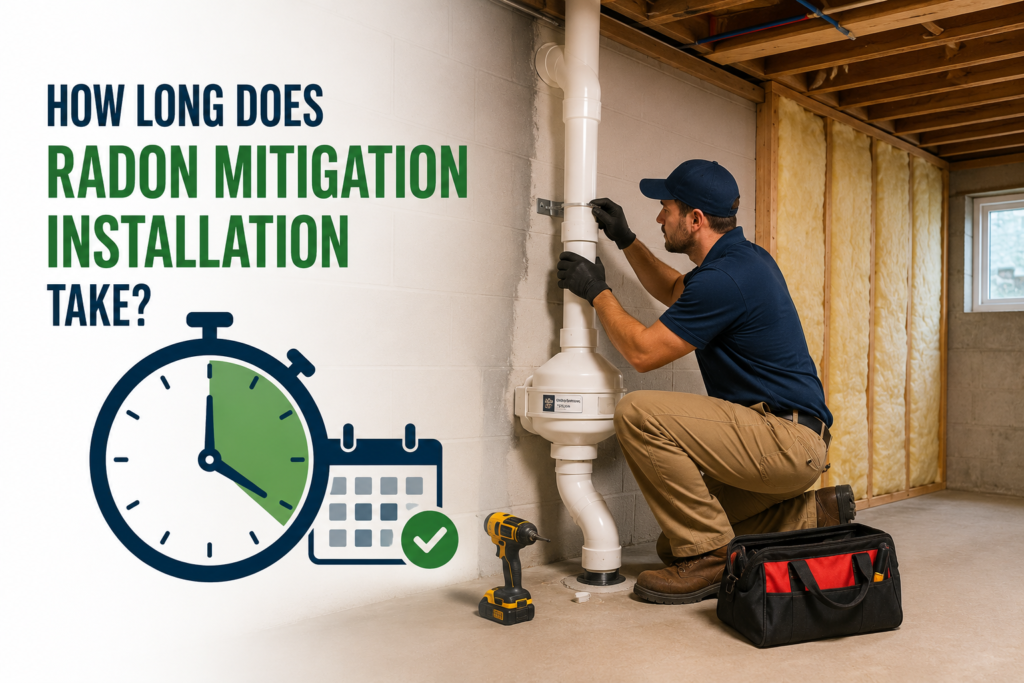
I get this question on almost every estimate I run: “How long is this actually going to take?” People picture a construction crew tearing up their basement for a week. After installing systems in hundreds of homes across St. Louis City, St. Louis County, and the Metro East side of Illinois, I can tell you the real answer usually surprises them.
The Short Answer, From Someone Who’s Done This Hundreds of Times
Most single-family homes in this region get a working system installed in two to four hours, start to finish, in a single visit. I’ve done plenty of jobs where I’m in and out before lunch. The homes that take longer are usually the ones with layouts I’ll walk through below, older fieldstone foundations, additions built at different times, or crawl spaces that need extra attention.
If you just got results back from radon testing St. Louis inspectors or a DIY kit and the number is over the EPA’s action level of 4.0 pCi/L, know this: fixing it is a much smaller project than finding out you had a problem in the first place.
What Actually Happens on Installation Day
The Walkthrough Comes First
Before I pick up a drill, I walk the property. I’m checking the foundation type, where the sump pit sits, how the framing is laid out above the basement, and where I can route a pipe to the exterior without it looking bolted onto the side of your house as an afterthought. On a typical ranch or two-story home this takes fifteen to twenty minutes. On older homes in neighborhoods like South City or parts of St. Charles, where additions were sometimes built decades apart on different foundation types, it can take a bit longer just to map out the airflow.
Drilling the Suction Point
Next comes the part that makes people nervous: the hole in the slab. I place this somewhere out of the way, a utility room corner, a spot behind the water heater, wherever makes sense so it isn’t sitting in the middle of a finished basement. This creates the point where the fan will pull air from beneath the foundation.
Running Pipe and Mounting the Fan
From that suction point, PVC pipe runs up through the house and out through the roofline or an exterior wall. I mount the fan along that run, usually in the attic or garage. That fan is the workhorse of the whole system. It runs around the clock, creating negative pressure under the slab so radon gets pulled out and vented above the roofline before it ever reaches the air you’re breathing indoors.
Sealing Foundation Openings
Last step is sealing up cracks, gaps around the sump lid, and other obvious entry points with a polyurethane sealant. Skipping this is like running your AC with a window cracked open. The system will still work, but the fan has to work harder than it should.
Once it’s all connected, I flip the fan on and check the manometer, that small U-shaped gauge mounted on the pipe, to confirm it’s pulling correctly. Then I walk the homeowner through what the system does and what to expect.
A Real Example From the Field
Last spring I mitigated a 1960s split-level in Kirkwood with a partial basement and a crawl space under the addition on the back of the house. A straightforward basement slab would have been a two-hour job. This one took closer to five hours because the crawl space needed its own vapor barrier and a second suction point tied into the same fan system to get consistent pressure across both foundation types. The homeowner’s test came back at 8.2 pCi/L before mitigation and 0.8 pCi/L on the post-test. That’s the kind of case where knowing your home’s specific foundation layout matters more than any general rule of thumb.
What Can Stretch the Timeline
Foundation Type
A poured concrete basement slab is the easiest scenario I run into. Crawl spaces and slab-on-grade homes, both common throughout the St. Louis metro, sometimes call for a vapor barrier system layered on top of the suction setup rather than a single hole through concrete. Homes with a mix of foundation types under one roof, which is common in additions built onto older houses, almost always add time.
Multiple Suction Points
Sometimes a single suction point can’t pull enough negative pressure across the whole slab, especially in larger homes or homes with dense clay soil underneath, which is fairly typical of this region’s geology. When that happens, a second suction point gets added, which means more drilling, more pipe, and more time spent verifying the whole system pulls evenly.
Roofline and Exterior Access
Steep rooflines, finished attics, and older homes with brick exteriors can slow down the fan placement and pipe routing. Finding a path that vents correctly and doesn’t look out of place on the house takes real judgment, not just a tape measure.
After the Fan Turns On
Confirming It Worked
I place a follow-up test 24 to 48 hours after activation to confirm radon levels dropped below the EPA’s 4.0 pCi/L action threshold. This step matters more than anything else in the process. A system that hasn’t been verified with a post-test is just a pipe and a fan making noise, not a confirmed fix.
Living With the System
You’ll hear a low hum from the fan and notice a small vent stack on the roofline or exterior wall. Beyond that, nothing about your daily routine changes. No lingering odors, no ongoing maintenance beyond an occasional glance at the manometer to make sure it’s still reading in the normal range.
Installation Time vs. Testing Time
Here’s the part that trips up almost every homeowner I talk to. Radon testing St. Louis residents schedule, whether short-term or long-term, actually takes longer on the calendar than the mitigation installation itself. A short-term test needs a minimum of 48 hours under closed-house conditions, and if your results land in that 4.0 to 10.0 pCi/L range, a follow-up long-term test might be recommended too. So the sequence usually looks like this: test for a couple of days, review the results, then schedule a single afternoon for mitigation. If you’re on a closing deadline for a home purchase or sale, this order matters. I’d rather a client build in extra days for testing than rush the mitigation appointment.
Why the Timeline Works in Your Favor
People assume that anything involving drilling into a foundation has to be a major renovation. It isn’t. Radon mitigation is one of the rare home health improvements where the fix takes far less time than the problem itself took to find. You’re not tearing out drywall or living with contractors for a week. A licensed technician shows up, installs a system that runs quietly in the background for years, and by the end of the day your indoor air is measurably safer.
If you’ve been putting off scheduling Radon Mitigation St Louis appointments because you assumed it would eat up your week, that concern generally doesn’t hold up in practice. For more detail on what installation actually costs in this market, see our radon mitigation cost guide, and if you’re still deciding whether you need testing first, our radon testing page walks through short-term versus long-term options.
Conclusion
A radon mitigation installation is quick work for a licensed technician, usually wrapped up in a single visit, with the EPA’s 4.0 pCi/L threshold used as the benchmark for a confirmed fix once the post-test comes back. The real variable isn’t the fan-and-pipe work itself, it’s your home’s specific foundation and layout. If you’ve had elevated radon testing St. Louis results and you’re worried the fix will take over your household for days, that fear usually doesn’t match reality. One visit, a few hours in most cases, and a system that quietly protects your family going forward. If you want a straight answer for your specific home, reach out to Air Sense Environmental for a free estimate. I’ll walk your foundation in person and tell you exactly what to expect before any tool comes out of the van.
FAQs
1. Can I stay in my house during radon mitigation installation?
Yes. There’s no need to leave. The work is contained to a small area of your basement or crawl space, plus the exterior wall or roofline where the pipe exits. Most homeowners carry on with their day while I work.
2. Will drilling into my foundation cause structural damage?
No. The suction point is a small, precisely placed hole, nowhere near large enough to affect your foundation’s structural integrity. I place it in a spot that avoids load-bearing elements and existing utility lines.
3. How soon after installation will I know if the system worked?
I run a follow-up test within 24 to 48 hours of activation. That gives you confirmed numbers showing whether radon levels dropped below the EPA action level.
4. Does a bigger house mean a longer installation?
Not necessarily. Square footage matters less than foundation type. A large single-story home on a simple slab can sometimes go faster than a smaller home with a mixed crawl space and basement foundation.
5. Is same-day installation realistic if I’m closing on a home soon?
Often, yes, for straightforward foundations. Build in a few extra days for scheduling and post-mitigation test